Visar inlägg med etikett färja. Visa alla inlägg

söndag, augusti 16

Juli/Augusti 2020 - Del II - Lofoten, Norge

 When going to Lofoten by ferry, especially during the high season, it is recommended to buy the ticket in advance. But since we didn't have an exact plan on when we would get there, we only looked for tickets two days before. 2/3 of the tickets for the ferry between Bodø and Moskenes (Lofoten) are sold in advance online, and the rest is available for "drop in" - cars that just arrive at the terminal. So when we looked online, all the tickets were of course sold out. We had a bit of a drive to get to the ferry terminal, and because we would pass Saltstraumen - one of the strongest maelstroms in the world - at its peak time, we decided to take our time and then head to the terminal and hope to catch the next ferry. 

First we made a stop to do a short hike in a beautiful forest, and after we continued the drive to Saltstraumen. From the parking we could walk to the top of a high bridge and watch the stream from above, rushing and whirling past. We spent only enough time there to enjoy the view and take some photos before driving all the way to the terminal in Bodø.

We were there just over an hour before the next ferry would leave, but there were enough cars and motor homes before us that we didn't make it. The next ferry was supposed to depart at 15.00, just 90 minutes later, but due to technical issues it it was cancelled, and we had to wait until 18.00. If we were to miss that one to, we would have to wait until 22.00. Normally, we would have had a pretty good shot at making the one at 18 since we had a good spot in the queue, but since all the people who had bought their tickets in advance for the cancelled ferry would now get a guaranteed spot at the next ferry, it wasn't sure they would be able to take any cars from the "drop in" queue.


There wasn't much to do but wait and hope, and we decided to do that while exploring the small town. We found some nice street art, coffee and ice cream, enough to keep us busy for a few hours, but eventually we walked back to our car to spend some time reading. Some of the cars ahead of us had decided to try their luck with a different ferry - it would depart at 17.00, but would make a few stops along the way and would take twice as long to get to Lofoten, but could on the other hand guarantee a spot. 

As we were waiting, the terminal staff came and told us they had managed to bring in an extra ferry which would depart at 17.30, and after waiting more than six hours we were finally on our way to Lofoten. Four hours later we arrived, and started looking for a tent spot. All places we looked at seemed to require parking fees - and only accepted cash or Vipps (the Norwegian equivalent of Swish) as payment. So with no way of paying, we had to find a spot along the road big enough for the car - this was a recurring problem/solution across Lofoten. Eventually we found a spot by a lake, though we later realized it might have been a bit too close to someone's house. No one kicked us out, though.
The next day we started by exploring the small village nearby, Å. It's famous for its traditional fishermen's cottages, "rorbuer" (some of which has been made into accomodation for rental) and for cinnamon buns baked according to a traditional recipe in a bakery that was first built in 1844. We decided to take a walk around the lake where we spent the night, but again really underestimated how long it would take us. We ended up on the wrong path for a while which was steep, muddy and difficult to follow, and it was very warm, but eventually we got down to the intended path and were able to follow the beautiful route the whole way, and enjoy the scenery. Once back, we of course rewarded ourselves with cinnamon buns.

As we kept driving north, we passed one of the main sights - Reinebringen - a mountain which you can hike to the top to get a beautiful view over Reine village and the archipelago. However, all parking spots, roads, and the entire village were packed with cars that it was impossble for us to stop there. And, seeing all the tourists heading towards that hike, we weren't sure that we even wanted to join them. So we kept driving. A bit further north was another famous spot, often recommended for wild camping - Kvalvika beach. We wanted to do a hike there and potentially set up camp, but again we were met by parking fees we couldn't pay and lack of parking spots. But Kvalvika beach is divided into two parts, Nordvika and Vestervika, separated by cliffs, and doing some research we found a hiking trail leading to Vestervika - the less popular part of the beach.

We ended up doing a three hour hike with all our overnight stuff, which was incredibly beautiful and serene. Once at the beach, there were already four other tents there (and a flock of sheep), but they were spread out across the big area, and wasn't at all like the twenty-something tents on the other part of the beach. We had a really nice evening, and I stayed up "late" to watch the sunset - we were roughly two weeks late to see the actual midnight sun, but a sunset at 23.15 is not too bad either. 

The next morning we packed our stuff and decided to walk across the cliffs to the other beach to get a different route back - it was very steep, quite crowded, and in the end we had to walk several kilometers along the road to get back to our car, so we much prefered the hike the day before. On the other hand, the popular Nordvika beach got most of the afternoon/evening sun and also had a trail going up the top of the nearby mountain where a lot of people surely got some amazing photos of the beaches from above.


The next day, we drove past another "Lofoten sight" - the two beautiful beaches Haukland and Uttakleiv, that you can also do a hike between. Having another sunny day, we were up for some beach time but concerned about running into crowds again - which we did. Already a kilometer before the actual beach parking of Haukland beach, there were cars parked along the road making it difficult to even drive, even worse to meet other cars, motor homes, or even to turn the car around. Which we quickly did. And drove past the masses of people that covered the (otherwise indeed pretty) beach. Instead we drove up to Eggum - a small village by the ocean that also had a long, pretty beach. The "parking lot" was an empty field probably used by the local kids to play soccer, but we only shared it with two or three other cars. The beach was almost empty, and we got to enjoy the beach and go for a swim (for fun, not even for "showering") in the cool, salty ocean at this quiet hideaway.


Feeling quite overwhelmed by the amount of tourists in these small areas, and stressed from driving on roads too narrow to handle the amount of traffic and large vehicles, we only spent one more day in Lofoten. We drove to the small city Svolvӕr, which is the "capital" of Lofoten. We stopped just outside of the city for a walk around a lake called Prestvattnet, with an amazing view over the mountain Tjeldbergtind, before heading into the city center to take a walk by the harbor, have a smoked salmon sandwich and a fika, before the clouds started rolling in. They were so low and heavy that all the surrounding mountains suddenly disappeared into the mist, and it almost seemed as if they didn't exist at all.

We found a spot that was actually marked on Google maps as a "tent spot" - even with free, available parking, and with only two other tents in the area. It was overlooking the fjord, and as we were eating our dinner that evening we saw an eagle fly by. As silly as it may sound, to me that felt like a sign that we were now done with Lofoten - a sort of closure, that made it feel like the right choice to get in the car the next day and head towards the Swedish border.


onsdag, augusti 12

Juli/Augusti 2020 - Del I - Helgelandskysten, Norge

 This trip was probably the least well-planned so far - or at least, the least planned. We hadn't really given much thought to where we wanted to go when we rented a car - we just knew we wanted to go north, do some hiking, be in the nature. First we thought to go somewhere around the mid-Sweden "mountains" (fjällen) and do one longer or a few shorter hikes. But then Norway opened their borders, and an idea we had entertained at some point before covid suddenly became available again - to pick up where we left off last time and head north of Trondheim up to Lofoten. So we did.

We weren't even 100% certain we would be allowed to cross the border, but with ID in hand and a proof of residency of southern Sweden did the trick, and late afternoon we set up our first camp spot by a lake somewhere not too far from Oslo.

The weather quickly turned unstable, and for the next few days it wasn't uncommon to have bright sunlight while also seeing dark, heavy rainclouds, though most of the time it was just raining. As we drove on Kustriksveien along Helgelandskysten, one of the National Scenic Coastal Routes of Norway, we felt a bit beaten down by the cold and unwelcoming weather, dreading that all sixteen days would look like that. But then we were out camping in Brønnøysund, and we were woken up by the sun shining on our tent - we felt incredibly grateful and happy.


So the day started with an early morning dip in the very cold ocean to wash off some travel dirt. Then we headed straight to Torghatten, one of the famous sights along this coastal route, also known as fv17. Torghatten is a 258 meter tall mountain with a very photogenic tunnel, formed during the ice age, going straight through it - though according to the legends, the hole was actually made by a troll named Hestmannen. Getting there early meant we managed to get a bunch of pictures there before the crowds arrived. Since the weather was so nice, we wanted to spend as much time as possible outside, so we decided to walk to the top as well. We would however regret doing that hike in walking shoes rather than hiking boots, as it turned out to be steep, sometimes slippery, and at times had to be climbed with the help from a chain. Nevertheless, we were rewarded with an incredibly beautiful 360 degree view of the surrounding ocean, islands, and mainland mountains.


Driving along Helgelandskysten, there are some parts where you need to take ferries across. This first sunny day we took two of those. Lacking planning, again, we thought the ferries would run pretty often (some of them do, not all of them), and when at the second port we decided to just "take the next one" in order to drink some coffee from a local roastery, we didn't anticipate that it would be more than 1,5 hours until the next ferry. Although, while we were "stuck" in the tiny village Forvik, walking around the harbor and eventually settling down to read, we saw one small weasel (?!) and also some dolphins. So I can't really say we regretted that decision too much. Oh, and of course, the coffee was also great.


Then we reached the area with the famous Syv Söstre (the seven sisters), 7 mountain peaks around 1000 meters high. It was already late afternoon, so climbing to the top was not an option. Instead we opted for a walk that would only be a couple of kilometers, but which included going up to the rim of the southernmost mountain. It turned out to be more of an adventure than expected, as the first part of the walk was very steep. Once on the rim, the wind was so strong that it was difficult to walk in, though it was also kind of nice, as it was still around 20 degrees and I was sweating a lot. The second part of the trail was very beautiful and we really enjoyed it, even though the whole walk took nearly 2,5 hours - one hour more than we expected.

As it was getting late, we drove to a beach on the same island. Several others had also picked it for a nice camp spot, but we managed to find a spot a little bit further away from everyone else. Wanting to make the most out of this sunny day, we didn't mind having a late dinner, especially since the sunset was not until around 23. We also had a real treat that day - during our lunch break by the ocean, we found mussels on the rocks and picked a bunch - we cooked these in salt water from the ocean and had them as a pre-dinner snack. They were very small, but it still felt incredible to me to be able to handpick mussels and then have them for dinner! All in all, we had a great day filled with sunshine and adventure, and we regained some hope. During the night it was very windy (like loud windy) sowe didn't sleep that well, but the sun was shining again the next morning. And actually, we had sunshine almost every morning after that.

The next day, we had another three ferries to take, one of which took as across the arctic circle. We also drove past Svartisen glacier, which is the lowest glacier in mainland Europe and the second largest glacier in Norway. Though the best part of that day might have been the tent spot we found on Litlsanden - a bit further north of the big beach Langsanden on Sandhornøya on which there must have been more than twenty tents. Instead we got a small beach to ourselves as well as a beautiful evening view from a little hill where we found endless amounts of the biggest blueberries we'd ever seen.

The next day we were headed for Lofoten, which I'll tell more about in next post. Though I will say that we started the day with another ocean "shower" on our little beach, took a walk in a beautiful forest, and visited Saltstraumen, one of the worlds strongest maelstroms, before testing our luck at the Lofoten ferry terminal. To be continued...


onsdag, januari 8

November 2019 - Raja Ampat, Indonesien - Del I

Första delen om vår dyksemester till Indonesien, specifikt om de första tio dagarna som spenderades ombord en liveaboard.

Raja Ampat sägs vara ett av världens bästa dykställen. Området är en stor marin nationalpark, vilket gör att de kan skydda korallreven och fiskarna. Det är beläget i närheten av Västpapua, och det är också dit man flyger när man ska ta sig till Raja Ampat. Vi hade en total restid på tjugosex timmar ner - vi flög med Qatar airways från Köpenhamn via Doha till Jakarta, där vi fick checka in vårt bagage på nytt inför sista etappen till Sorong med det lokala flygbolaget Garuda Indonesia. Väl framme i Sorong checkade vi in på ett hotell i närheten av flygplatsen. Vi var ganska utmattade och spenderade större delen av dagen (och natten) med att sova.

Tidigt nästa morgon checkade vi ut och gick till ett annat hotell i närheten, där vi blev upplockade med bil och körda till färjeläget. Vi mötte upp några av de andra som också skulle med samma liveaboard som vi, och satte oss sedan på den cirka två timmar långa färjan till Waisai, som man kan säga är själva porten ut till Raja Ampat-området.

Vår liveaboard var en stor, ombyggd segelbåt med såväl soldäck och lounge som plats för all dykutrustning. Vi var 12 dykare på båten, tre dykguider plus besättningen. Jag och Valle hade en egen koj under däck som var precis så stor att det fick plats en våningssäng och lite utrymme för väskorna.


Efter att vi packat upp vår dykutrustning och gjort ett testdyk började vi åka söderut mot ön Misool. Vi gjorde oftast tre eller fyra dyk om dagen, och däremellan fanns det lite tid att läsa, vila eller umgås. En vanlig dag kunde se ut såhär:

07.00 Vakna, dricka en kopp kaffe på soldäck
07.30 Dyk 1
09.00 Frukost
10.30 Dyk 2
12.00 Lunch
14.00 Dyk 3
15.30 Snacks, sitta på soldäck tills solen gick ner
18.00 Kvällsdyk
19.30 Middag
21.00 Läggdags

Varje måltid var en liten "buffé" med lokal mat. Ofta fanns det ris, köttgryta, ångkokta grönsaker, tofu eller tempeh, sambal, och någon frukt till efterrätt. Till frukost kunde det ibland bara någon söt lins- eller bönröra, pannkakor eller ägg. Hela dagen fanns det tillgång till juice, flingor med mjölk, och rostat bröd med marmelad, jordnötssmör och Nutella, och frukt. Vi kunde också köpa öl eller läsk. På eftermiddagen serverades ofta någon mjuk kaka eller friterad banan, sötpotatis eller grönsaker.


nudi branch

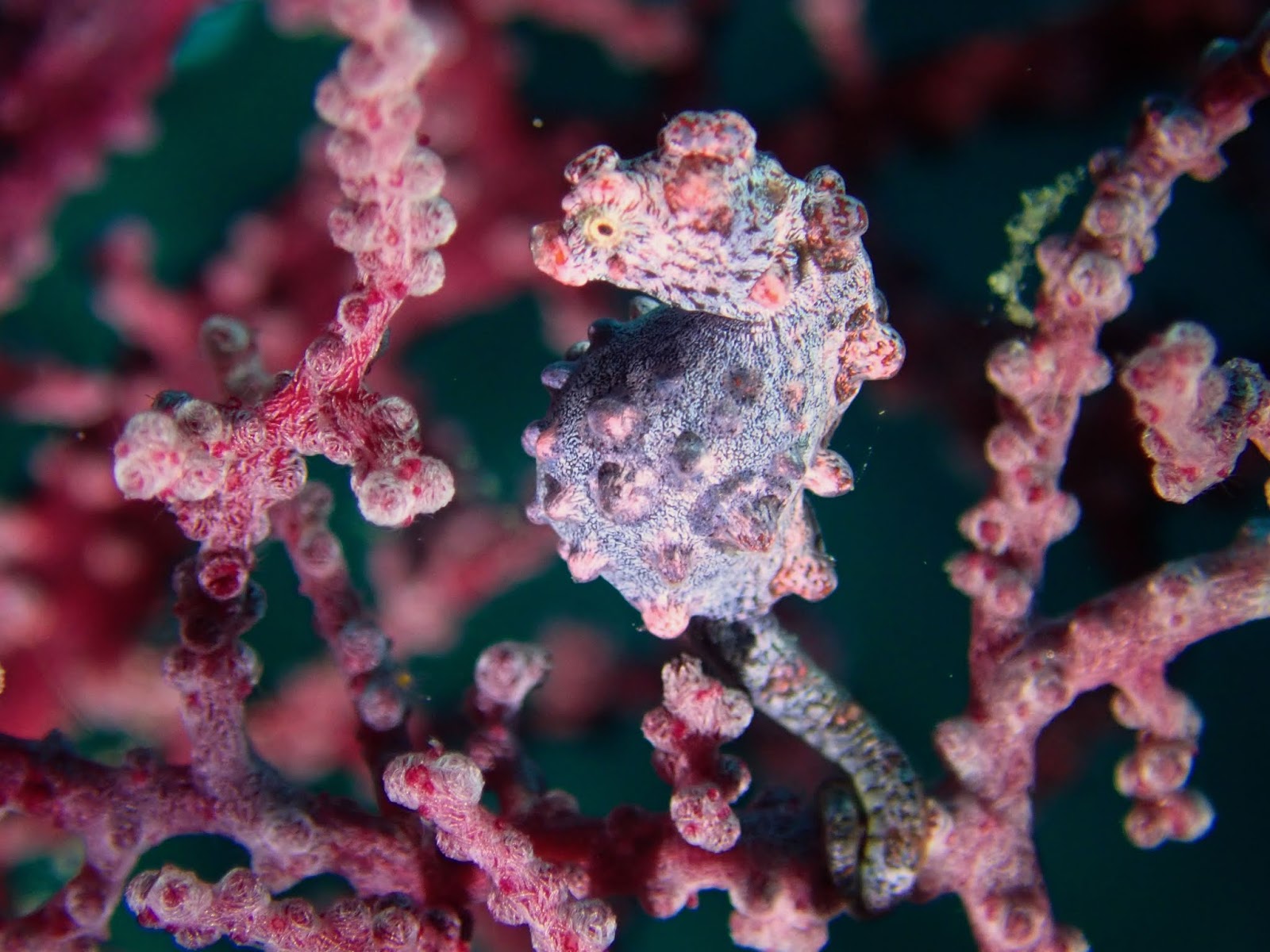
santa clause pygmy seahorse, endemic to the Misool-area

Det var otroligt bekvämt att bo så med allt inkluderat, och varje dag njöt vi av fantastiska dyk och en vacker utsikt över omkringliggande öar och hav. Ofta hade vi delfiner som hoppade en bit bort, och såväl soluppgångar som solnedgångar var såklart magiska. Man hann och orkade inte göra så jättemycket utöver dykningen,men det var ju också det som vi var där för. Och visst var det precis så fantastiskt som vi hade väntat oss. Jag har nog aldrig sett så mycket fisk någon annan stans, som vi gjorde i det här området. Det kanske bästa av allt (för mig iallafall) var att få se mantas. Valle har sett dem förut, men för mig var det första gången och det är verkligen häftigt. Att se dem simma sina rundor eller svepa förbi någon knapp centimeter ovanför en känns nästan overkligt. De är väldigt graciösa, och väldigt stora. De "vanliga" reef mantas är oftast 2-5 meter breda, men vi hade också turen att få se en Oceanic manta, som var ungefär 7 meter bred. Det var verkligen en upplevelse!

oceanic manta ray


Vi såg såklart mycket annat häftigt också - revhajar, nudibranchs, bläckfiskar, cuttlefish, pygmésjöhästar och "stora" sjöhästar, pipefish med mera. Vi hade fantastiska dyk i Misool-området, men även på tillbakavägen till Waisai fick vi några riktigt bra dyk runt ön Batanta.

pygmy seahorse

ornate ghost pipefish


thorny seahorse

reef squid

pygmy squid

Överlag var vi väldigt nöjda med liveaboarden - det är ett väldigt bekvämt liv där allting är ordnat, och det finns trevligt sällskap och gott om god mat. Och man har aldrig tråkigt! Men efter tio intensiva dagar såg vi också fram emot att ta det lugnt några dagar och verkligen varva ner...

---------------------------- Text in English --------------------------------------

The first part about our diving vacation in Indonesia, and more specifically about the first ten days, which we spent on a liveaboard.

Raja Ampat is said to be one of the best areas for scuba diving in the world. The area has a big marine national park, which helps protecting the coral reefs and fishes. Raja Ampat is situated near West Papua, which is where you fly to when getting there. We had a total travel time of 26 hours (heading out) – we flew with Qatar airways from Copenhagen through Doha to Jakarta, where we had to check in our luggage again as we were switching to the local flight company Garuda Indonesia for the final leg to Sorong. Once in Sorong, we checked in at a hotel near the airport. We were pretty exhausted, and spent the majority of the day (and the night) sleeping.

Early next morning we checked out and walked over to another hotel nearby, where we were picked up with a car and taken to the ferry. We met up with some of the other boat guests, and then got on the two-hour ferry to Waisai, which is more or less the gateway to the Raja Ampat area.
Our liveaboard was a large, rebuilt sailingboat with a sundeck and lounge as well as space for all the diving equipment. We were twelve divers on the boat, three diveguides plus the crew. Valle & I had our own cabin below deck, just big enough for a bunk bed and some space for our bags.
After unpacking and setting up the diving equipment, we had a check dive in the area before heading down towards Misool island. We usually did 3-4 dives per day, and in between there was some time for reading, resting or socializing. A regular day could look something like this:

7am – wake up, have coffee on the sundeck
7.30am – first dive
9am – breakfast
10.30am – second dive
12pm – lunch
2pm – third dive
3.30pm – snacks, watch the sun set from the sundeck
6pm – nightdive
7.30pm – dinner
9pm – bedtime
(for me, it was usually too hot to stay in the sun between 9am-4pm)

Every meal had a selection of local dishes. Often we got rice, stew, steamed vegetables, tofu or tempeh, sambal, and some fruit for dessert. For breakfast we could get some sweet lentil- or been sauce, pancakes, eggs or fried rice. Throughout the day we could always get juice, cereal, toast with jam, peanut butter or nutella, and fruit. We also had the possibility to buy sodas or beers. The afternoon snack was usually some sort of sponge cake or deep fried banana, sweet potato or vegetables.

It was incredibly comfortable to live like this where everything was included, and every day we got to enjoy amazing dives and a beautiful view over nearby islands and ocean. Often we saw dolphins jumping some distance away, and both sunrises and sunsets were of course magical. There was barely time or energy to do much except diving, but that was what we were there for. And it did not disappoint. I don’t think I’ve ever seen so much fish anywhere else as we did in this area. Probably the best part (for me at least) was seeing mantas. Watching them circle around you or swoop down just above your head feels almost surreal. They are very gracious, and very big. The “regular” reef mantas are usually around 2-5 meters across, but we were also lucky enough to get to see an oceanic manta, about 7 meters across!

Of course, we saw lots of other cool stuff as well – reef sharks, nudi branchs, octopus, squid, cuttlefish, pygmy seahorses (and regular seahorses), pipefish and more. We had amazing dives in the Misool area, but on our way back to Waisai we also got some really good dives around Batanta island.

Generally we were really happy with our liveaboard – it’s a very comfortable life where everything is taken care of and provided, and there is great company and plenty of good food. And  you never get bored! Though after ten intense days, we were also looking forward to simply relaxing for a couple of days to really wind down…

tisdag, augusti 21

Juli/Augusti 2018 - Roadtrip i Norge - Del I

Så var det dags för första delen om vår resa till Norge - tolv dagar i bil/tält tillsammans.
Vi skulle ge oss av tidigt på lördagen. Valle åkte iväg för att hämta hyrbilen, och sen bar vi ner all packning: varsin stor och liten ryggsäck, en sportbag med extra kläder, två lådor med mat, en vattendunk samt bord och två stolar. Vi köpte med oss falafel till lunch och gav oss av med en gång. Vi visste att vi hade en lång körning framför oss - det rådande totaleldförbudet i Sverige gjorde att vi var tvungna att åka över till Norge för att få använda vårt stormkök. Här ska noteras att vi inte var hundra procent säkra på att det inte var totalt eldförbud i Norge också; det skulle visa sig i slutet av resan att det inte räcker med att googla "som vanligt", utan att man måste googla på norska för att få fram den typen av norsk information. Våra försök till efterforskningar gav inga resultat som antydde att det skulle vara olagligt, och eftersom det inte heller stod något på Norges officiella tursitsajt VisitNorway, så antog vi att det var okej. Hur som helst startade vi inte några bränder, och det var ju ganska "fuktigt" väder dessutom.

Ganska slumpartat tog vi sikte på en sjö, och trots en ganska slingrig väg dit visade det sig bli en helt okej tältplats. En vacker, stillsam kväll och fullkomligt omgivna av blåbärssnår. Jag har nog aldrig sett så mycket blåbär som vi gjorde under denna resan - det blev alltså blåbärsgröt till frukost i princip varje dag. Under natten drog det dock in ett ordentligt oväder med regn och blåst, vilket chockade oss lite efter att ha kommit från den svenska värmeböljan.


Nästa dag började äventyret på riktigt. Vi körde till fjället Glofökkampen och den närliggande campingen Johnsgård. Där fick vi tillåtelse att parkera över natten för att kunna ta en vandringstur runt fjället. Det här blev premiärturen för mina kängor och första gången på länge som jag gått med tung packning, och det var definitivt lättare sagt än gjort! Med en brant start på vandringen tog det inte många meter innan jag hade ordentlig mjölksyra, så denna första vandring gick inte särskilt fort. Till slut tog vi oss dock upp på "kammen" och ner på andra sidan, där vi skulle tälta. Redan när vi var påväg för att starta från gården kom det fram en glad och gullig hund och hälsade på oss. Det visade sig att han också var pigg på att vandra, för han utsåg sig själv till följeslagare/vägvisare och lunkade med oss hela vägen till vår tältplats. Han verkade stortrivas på fjället, och inte ens när vi vek av från stigen för att slå upp vårt tält lite längre bort gav han sig av. Han stannade hos oss ända tills vi ätit middag och skulle gå och lägga oss, och verkade trivas med lite sällskap.


När vi vaknade hade vår fyrbenta vän återvänt till gården, och vi hade en bra bit att gå då vi skulle runda fjälltoppen. Ganska snart efter att vi börjat gå visade det sig att kartan vi hade tagit med oss och stigarna inte alls stämde överens, och det blev en ganska snårig och bitvis blöt promenad tillbaka, och då är vi (mest jag) trötta och hungriga. Vi körde vidare och lunchade vid en rastplats på vägen. Återigen tog vi sikte på en tältplats vid en sjö, men det visade sig vara ett avgiftsbelagt område där man endast kunde betala med Vipps (norska swish), så vi vände. Vi tänkte åka ner och tälta i dalen, men hade svårt att hitta någon bra väg ner, så tillslut hamnade vi istället vid en fjälltopp, Hessdalen. I detta området har man siktat oförklarliga ljusfenomen vid ett flertal tillfällen, och informationsskyltarna hade kompletterats med fyndiga vägskyltar som varnade för UFOn. Även stigen upp till toppen hade fått några plattformar som skulle lämpa sig utmärkt för UFO-spaning. Vi traskade inte hela vägen upp till toppen, utan nöjde oss med att slå upp tältet en liten bit längre ner. Det var otroligt blåsigt, men vilken fantastisk utsikt vi hade! Och återigen, fullt med blåbär.


Nästa dag tog vi sikte på Trondheim, som skulle bli vår nordligaste punkt på resan (och dessutom den nordligaste punkten i Europa som jag någonsin besökt). När vi skulle stanna för lunch hittade vi en flod där vi kunde stanna för att laga mat och för att ta en välbehövlig "naturdusch". När vi väl kommit fram och lyckats parkera inne i Trondheim visade det sig att vi var tillbaka i värmeböljan för en dag. I gassande sol och över 30 grader gjorde vi vårt bästa för att strosa runt och upptäcka staden. Vi besökte domkyrkan, kollade runt på en medeltidsmarknad och beundrade husen längs kanalen, som med sina glada färger påminde oss lite om Köpenhamn. Efter att ha vilat i skugga på ett fik (som förståeligt nog hade slut på is) kände vi oss ganska nöjda och trötta med stadsbesöket. Vägen ut ur staden blev dock längre än vi trodde, då en bilolycka i de komplicerade rondellerna orsakade trafikstopp i en timme. Till slut lyckades vi komma bort från stan och ut i naturen igen. Kvällens tältplats blev en väldigt snårig plätt i närheten av en strand. Den krångliga eller bökiga promenaden till en blivande tältplats blev alltid kompenserad av en vacker utsikt, som tur var.


På vår femte dag kom vi äntligen ut till kusten. Vi åkte med vår första bilfärja och njöt av att vara vid havet. Vi kom också fram till den första turistvägen, Atlanterhavsveien, som skulle kunna ses som Norges motsvarighet till Great Ocean Road. Sträckan har bland annat en rad stora broar som knyter ihop ett pärlband av små öar i skärgården, och bjuder på flertalet vackra utkiksplatser där man kan stanna till, ta bilder och köpa souvenirer. Här spenderar vi lite extra tid och njuter av (den mer rimligt varma) solen och utsikten. Vidare kommer vi till en stor strand, Farstadsanden, som ska vara världens nordligaste sydvända sanddyner, eller något i den stilen. Hur som helst är det en väldigt fin strand, och vi njuter av ett friskt dopp i Atlanten. Återigen har vi problem med tältplatsen - vad som ser ut att vara mossbeklädd sten var egentligen våtmark med förrädiska hål.

Nästa morgon fick vi en tuff start på dagen då vi vaknade upp till svärmar av något slags knott som inte ville lämna oss ifred. Dessutom insåg vi att havregrynsgröt kokat med vatten från Atlanten inte direkt är någon hit... Som tur var hade vi äventyr att se fram emot under dagen - mer om det i nästa del!