Visar inlägg med etikett soluppgång. Visa alla inlägg

tisdag, april 5

Mars 2022 - Nicaragua - León, Granada

Coming from the cool February weather in Honduras, the moment we stepped off the bus at the border to Nicaragua it felt like we were in the desert. The dry heat and scorching sun caught us a bit off guard. Once again we got dropped off by the side of the road in the dark, as our bus headed to San José while we made León our first stop in the country. León was a nice town with a strong backpacker vibe. Surrounded by volcanoes, there are enough activities to keep you occupied for days. We stayed our first two nights at Vía Vía, a backpacker hostel which also hosted one of the biggest tour agencies in the town - Volcano Day.

The first day we took our time to walk around the city, look at the colorful colonial buildings, and visit museums. First, we visited the Museum of Traditions and Legends, a small museum where we could read about myths, legends, folklore and fables. While the museum itself didn't feel like it was very well-visited, the stories were quite interesting - they seemed a bit weird and crazy, but then again most myths and legends do! It was even more rewarding when we returned to our hostel and saw that they had an entire mural depicting most of these mythical people and creatures; had we not gone to that museum we would have had no idea what we were looking at.

The second museum we visited was Museum of the Revolution. We were a bit surprised to find out that this was not a museum where you go around looking at things yourself. There was a single guide, who himself had participated in the revolution, who walked the tourists around the building and told the whole story, while showing old photographs and articles. With a mix of Spanish and English, he made sure everyone got the full story, even those who joined us when we had only gotten halfway. The tour of the building ended with a very sketchy walk up on the half broken tin roof (which had arrows painted on it to show where you needed to step) to show some views of the city. It was definitely a museum experience out of the ordinary.

view from a sketchy rooftop

In the afternoon, we took a shuttle from our hostel to the beach, which was only $2 for those who had booked a tour with Volcano Day. We spent a few hours reading and watching surfers, and then watched one of the most beautiful sunsets we've seen. Out of all the sunsets that we've seen, this was definitely special.


The next day we went on our Volcano Day tour. They offer tours to most of the surrounding volcanoes, but several of them were very expensive since the roads are pretty bad and you need a 4x4 to reach the starting points. The most popular tour here was to go volcano boarding - basically you get an overall and a board/sled and you get to go down the sandy slopes of Cerro Negro pretty fast. We thought this might be a bit touristy for us (there were big groups going from many different tour operators every day) so we instead picked something we thought would suit us a bit better: an overnight hike to Volcán Telica, around 1030 m high. Our group was very small, as we were joined only by two more people, one of which who was working as a volunteer at the hostel, plus our guide. As we started the hike around midday, the trail up was hot, dry, and dusty. We set up camp near the top and went up to the very big and impressive crater, where we watched the sun set over the volcanoes to the west. In the morning, we walked the short path up to the crater again to watch the sun rise over the volcanoes to the east, before taking a short route down on the other side where the car to take us back was waiting. We had a really nice time at Telica, and the only thing we could complain about was that we wished we got a little more food.


On the topic of food, our go-to in León was a spot behind one of the churches where some women served various grilled treats and you can just point at the ones you want. A lot of them were meat of course, but we also found some nice halloumi-like cheese, cheese filled potato, fried yuca, fried banana and more. Served of course with some salad, and the traditional Nican gallo pinto - rice with beans.

Our next destination in Nicaragua was Granada, a town that felt even more touristy but less backpack-y. A long walking street packed with restaurants selling the same type of food and offering the same happy hour deals, but every single one playing different music - seemed to be targeting mostly local tourists. We found our own favorite spot at Pan de Vida - a brick oven bakery/pizza place with a cozy backyard. While we found their pizza to be more like crisp bread with topping, their huge slices of banana bread, big cinnamon rolls, great coffee, and cocktail deals to match the walking street (2 cocktails for $3) had us coming back on a daily basis.

Like León, Granada also offers volcanoes to see. After inquiring at a tour agency, we decided to visit Volcán Mombacho, 1344 m, on our own, hoping to save some money by taking a chicken bus. However, we found out that it was not really a cheap deal to visit Mombacho. Being an old, tree-covered volcano, it had three walking trails on the top, and the way to that top was about 5km long and very steep. As we got to the ticket office, we were informed that a car ride up would cost an additional $15 on top of the $5 that was the entrance. Then, we would have to pay a second fee depending on which trail we wanted to walk - the shortest one cost only $2, while the longest one which we were hoping to walk, was $6 but also required a guide, which would cost an additional $17 for a Spanish-speaking guide, or $22 for and English-speaking guide. Since we thought the car ride up the mountain was too expensive we wanted to walk up, but figured we would likely be too tired to walk the long trail when we got there, so in the end we only payed $7/person, but indeed we got a lot of exercise!

howler


That road up the mountain was really steep, almost the entire way. At least, we got to see a lot of howler monkeys, and we got a nice view at the top. The heat had us compeltely drenched, though, and tired. Walking down that steep hill again was not much easier. We wanted to take a little detour on our way back and took a chicken bus to Masaya, famous for its craft market. However, we got there tired and hungry and had to hunt down some quesillos (quite similar to pupusas - cheese filled tortillas) first. When we got to the market it was late enough that it was empty of people and most stalls starting to close up, but we did have enough time to find two small vases as souvenirs.

The next day, as our legs needed some rest, we decided to let the upper half of our bodies work instead! We rented kayaks, and headed out among the islets of Granada, 365 small islands in Lake Nicaragua that were formed as a reaulst of an eruption by Mombacho, a very long time ago. It was very beautiful, and quite nice to just paddle around the different islands. Some hosting fancy resorts or houses, while others were home to monkeys, or bats that camouflaged against the bark of a tree. The tamales that we had bought at the market and brought for lunch though was a bit disappointing as they had no flavouring or filling at all, not even salt I think - not at all like the big and tasty nacatamal that we had bought from a kiosk on the square two days before. As we found it was time to paddle pack to mianland, the sun was already high in the sky and we nearly got burnt to crisps before we got back. After another day filled with adventure, we enjoyed some gallo pinto with cheese and tajadas (banana chips here) with an iced cacao drink from our favorite kiosk.


Overall, we preferred León over Granada as we found it to have a nicer atmosphere and better and cheaper food. The cheap and high quality cocktails in Granada was a nice treat though!

fredag, februari 25

Februari 2022 - Guatemala - Antigua, El Paredón

The first thing we noted (and liked) about Antigua was the many restaurants serving local food, something we felt were missing in both Flores and San Pedro La Laguna. Our hotel was located right across the street from the local market, which had an entire section just for small eateries. While somewhat overwhelming as they all were very persistent trying to get us to eat at their place rather than the next one (even though they all seemed to serve the same dishes), we saw several new things on the menus and the ones we tried were very good. One night we also found some street food in a small park - a tostada with a huge pile of beans, guacamole and veggies was definitely a treat!

The one activity though that most backpackers traveling through Antigua sign up for is to hike the volcano Acatenango. The volcano hasn’t erupted for many years and is considered safe to climb. With 3976m at the summit, it is nearly as tall as Mt. Kinabalu (4095m), the tallest mountain we have climbed (and the tallest peak in South East Asia). However, the main draw of the Acatenango hike isn’t the summit, but the nighttime view of the very active volcano next to it, Fuego.

Having read some about the hike and that it seems you get what you pay for, we decided to go for a “mid-range” tour operator – not the cheapest one, but not the most expensive either. The travel agency we booked with were very helpful, but unfortunately the information they gave us was wrong on a few points: when we asked about the group size, they first told us we would barely walk in a group at all – we would just get together around meals (which was not true, as during the hike we had to stop multiple times to wait for the people who walked the slowest); they also told us the bus would only be half full due to the pandemic, so maximum 10-12 people in the group (we were 22); and they told us we would only need to carry water and our warm clothes ourselves (yet on the bus we were given food packs which many people didn’t really have space for and had to carry by hand). Another odd thing was that when we stopped with the bus to pick up some warm clothes for people who wanted to borrow, a guy came on and told us it would be possible to do an extra hike to get closer to Fuego – but it was pretty expensive and we had to decide right then and there. We thought this felt a bit sketchy and declined. However, once it was time for that extra hike we were able to go along anyway, for the same price, and it was well worth it.


The first part of the hike took about 5 hours, mainly due to the many breaks we took along the way. At some point it was a bit annoying, as it could get pretty cold standing still, and it often felt like the breaks were way longer than needed. Along the way we had beautiful views of the surroundings. Once we reached our base camp at 3,600m we were assigned to tents – thankfully, the travel agency had at least given us the correct information that we would get a private tent. Then it was time for those who wanted to do the extra hike to Fuego, which was a strenuous 1,5h more, first downhill and then uphill to get to the rim of Fuego. Settling on the rim at a safe distance from the actual peak, we huddled up with our cameras ready and waited for the sun to set. Fuego has eruptions around once every 10 minutes, of varying sizes, but when it’s dark it looks incredible – like natural fireworks. It was freezing cold up there, and we waited for nearly two hours, watching the (mostly small) eruptions. Around 8pm it was time to head back to the base camp for dinner, but we only made it about ten steps before we heard the rumbling of a really big eruption and we turned around to see the lava being spit out and lighting up the whole top of the volcano – it was one of the most amazing things I’ve experienced.


After the 1,5h back to base camp we just had a quick dinner and then huddled up in our tent, trying to get some sleep as we had to make an early start for the summit. We didn’t sleep much though, and a few times during the night we would peek out of the tent to watch more big eruptions from Fuego. At 4.30am we started getting ready for the summit hike, which included putting on every single piece of warm clothing we had – the temperature at the summit is often around 0 degrees Celsius. We made it just in time for the sunrise, though we had to wait a bit extra for the sun to get past the clouds in the horizon. Still, it was a beautiful morning to spend on top of a volcano.


The hike back down went pretty fast, and back in Antigua we were happy to take a warm shower, get all the dust off and rest our tired feet. We had a few more days in Antigua which we spent walking around looking at pretty buildings, visiting museums (including a chocolate museum and a jade museum), taking a free salsa class, and trying craft beers at a local brewery. One of the days we took a cooking class, to experience more of the local cuisine and learn about the dishes and ingredients. The first dish we made was pépian, a flavorful stew with lots of spices that felt like something we would love to cook and eat around autumn in Sweden. We also made rice which was cooked with some spices and veggies, and a side dish which consisted of slices of a local variant of squash, with some local cheese (similar to feta) in between – and dipped in an egg based batter and deep fried. We also got to make tortillas, which was much more difficult than we could have imagined, and which left us even more impressed by the local women who do this all day every day and make it look like the easiest thing. For dessert, we cooked plantains (similar to bananas) and filled them with a mole of bean paste, local chocolate and sugar, and then deep fried them. It was a big, hearty, and tasty meal! It was so much food that we got to take some with us to have for dinner as well.


All in all we really enjoyed our stay in Antigua. We nearly made it our last stop in Guatemala, but we heard a few people at different occasions who warmly recommended El Paredón, so we thought, why not give it a visit? El Paredón is a small town by the coast, with black, hot, volcano sand and waves that vary in size throughout the day to cater surfers of various levels. It appeared to be a more relaxed and calm version of the famous surf spot El Tunco in El Salvador. It was definitely a nice place to just relax, read a book and be lazy. However, there are plenty of activities to engage in – our hostel offered not only surf boards for rent, but also beach volleyball opportunities and a slack line to practice your balance. We did rent a board for a day, but since it was seven (!) years since we last tried it, we were happy to be able to catch a bunch of the smaller waves. It felt like a great way to finish off our stay in Guatemala, except that I managed to get food poisoning (likely from aguachile, which was like a ceviche but in a different sauce). At least, a hammock by the beach is not the worst place to be sick and thankfully it only lasted for a day. I was enough recovered at least, to be able to spend a couple of hours on buses back to Antigua and onwards to El Salvador.


onsdag, januari 8

November 2019 - Raja Ampat, Indonesien - Del I

Första delen om vår dyksemester till Indonesien, specifikt om de första tio dagarna som spenderades ombord en liveaboard.

Raja Ampat sägs vara ett av världens bästa dykställen. Området är en stor marin nationalpark, vilket gör att de kan skydda korallreven och fiskarna. Det är beläget i närheten av Västpapua, och det är också dit man flyger när man ska ta sig till Raja Ampat. Vi hade en total restid på tjugosex timmar ner - vi flög med Qatar airways från Köpenhamn via Doha till Jakarta, där vi fick checka in vårt bagage på nytt inför sista etappen till Sorong med det lokala flygbolaget Garuda Indonesia. Väl framme i Sorong checkade vi in på ett hotell i närheten av flygplatsen. Vi var ganska utmattade och spenderade större delen av dagen (och natten) med att sova.

Tidigt nästa morgon checkade vi ut och gick till ett annat hotell i närheten, där vi blev upplockade med bil och körda till färjeläget. Vi mötte upp några av de andra som också skulle med samma liveaboard som vi, och satte oss sedan på den cirka två timmar långa färjan till Waisai, som man kan säga är själva porten ut till Raja Ampat-området.

Vår liveaboard var en stor, ombyggd segelbåt med såväl soldäck och lounge som plats för all dykutrustning. Vi var 12 dykare på båten, tre dykguider plus besättningen. Jag och Valle hade en egen koj under däck som var precis så stor att det fick plats en våningssäng och lite utrymme för väskorna.


Efter att vi packat upp vår dykutrustning och gjort ett testdyk började vi åka söderut mot ön Misool. Vi gjorde oftast tre eller fyra dyk om dagen, och däremellan fanns det lite tid att läsa, vila eller umgås. En vanlig dag kunde se ut såhär:

07.00 Vakna, dricka en kopp kaffe på soldäck
07.30 Dyk 1
09.00 Frukost
10.30 Dyk 2
12.00 Lunch
14.00 Dyk 3
15.30 Snacks, sitta på soldäck tills solen gick ner
18.00 Kvällsdyk
19.30 Middag
21.00 Läggdags

Varje måltid var en liten "buffé" med lokal mat. Ofta fanns det ris, köttgryta, ångkokta grönsaker, tofu eller tempeh, sambal, och någon frukt till efterrätt. Till frukost kunde det ibland bara någon söt lins- eller bönröra, pannkakor eller ägg. Hela dagen fanns det tillgång till juice, flingor med mjölk, och rostat bröd med marmelad, jordnötssmör och Nutella, och frukt. Vi kunde också köpa öl eller läsk. På eftermiddagen serverades ofta någon mjuk kaka eller friterad banan, sötpotatis eller grönsaker.


nudi branch

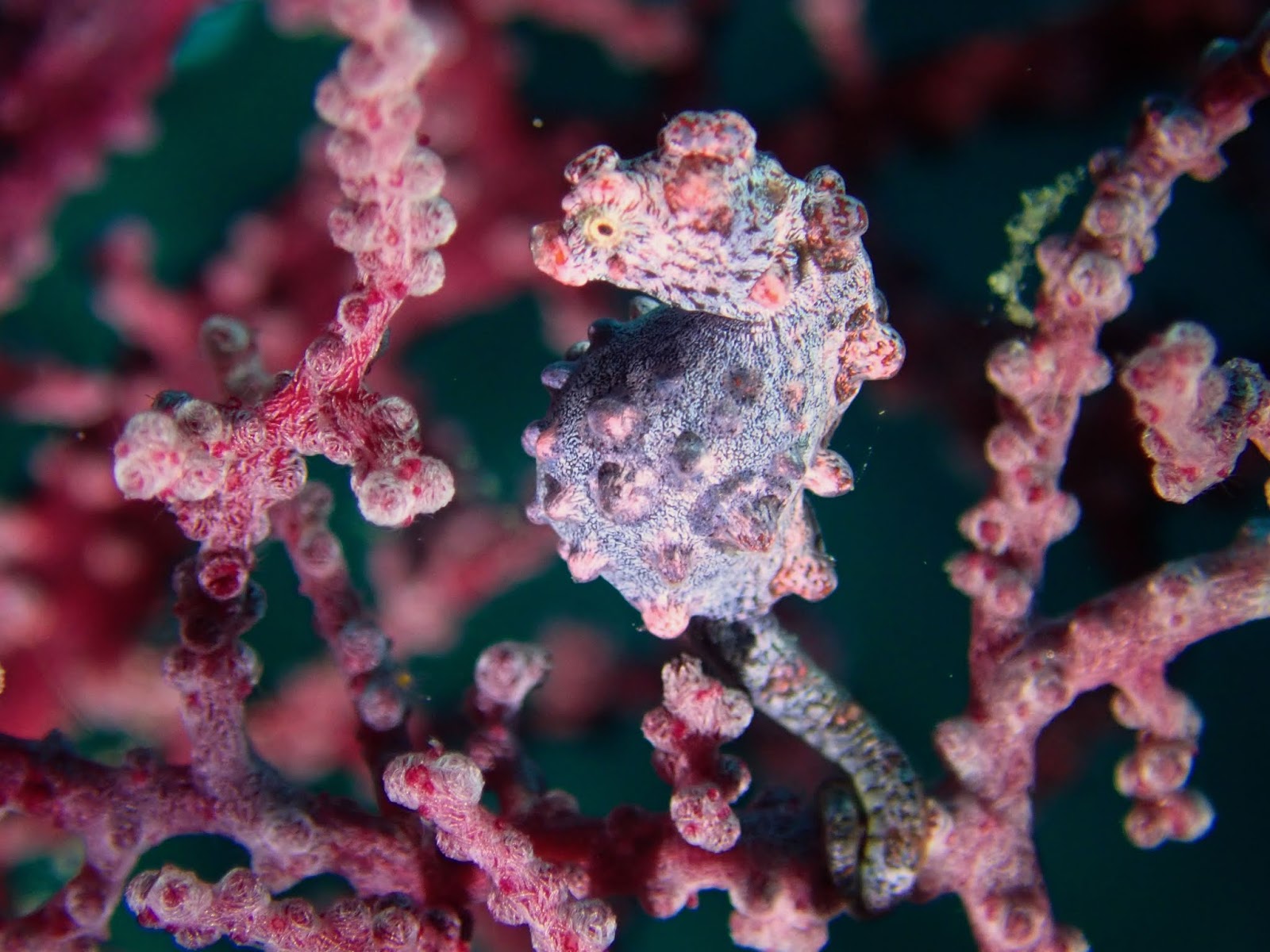
santa clause pygmy seahorse, endemic to the Misool-area

Det var otroligt bekvämt att bo så med allt inkluderat, och varje dag njöt vi av fantastiska dyk och en vacker utsikt över omkringliggande öar och hav. Ofta hade vi delfiner som hoppade en bit bort, och såväl soluppgångar som solnedgångar var såklart magiska. Man hann och orkade inte göra så jättemycket utöver dykningen,men det var ju också det som vi var där för. Och visst var det precis så fantastiskt som vi hade väntat oss. Jag har nog aldrig sett så mycket fisk någon annan stans, som vi gjorde i det här området. Det kanske bästa av allt (för mig iallafall) var att få se mantas. Valle har sett dem förut, men för mig var det första gången och det är verkligen häftigt. Att se dem simma sina rundor eller svepa förbi någon knapp centimeter ovanför en känns nästan overkligt. De är väldigt graciösa, och väldigt stora. De "vanliga" reef mantas är oftast 2-5 meter breda, men vi hade också turen att få se en Oceanic manta, som var ungefär 7 meter bred. Det var verkligen en upplevelse!

oceanic manta ray


Vi såg såklart mycket annat häftigt också - revhajar, nudibranchs, bläckfiskar, cuttlefish, pygmésjöhästar och "stora" sjöhästar, pipefish med mera. Vi hade fantastiska dyk i Misool-området, men även på tillbakavägen till Waisai fick vi några riktigt bra dyk runt ön Batanta.

pygmy seahorse

ornate ghost pipefish


thorny seahorse

reef squid

pygmy squid

Överlag var vi väldigt nöjda med liveaboarden - det är ett väldigt bekvämt liv där allting är ordnat, och det finns trevligt sällskap och gott om god mat. Och man har aldrig tråkigt! Men efter tio intensiva dagar såg vi också fram emot att ta det lugnt några dagar och verkligen varva ner...

---------------------------- Text in English --------------------------------------

The first part about our diving vacation in Indonesia, and more specifically about the first ten days, which we spent on a liveaboard.

Raja Ampat is said to be one of the best areas for scuba diving in the world. The area has a big marine national park, which helps protecting the coral reefs and fishes. Raja Ampat is situated near West Papua, which is where you fly to when getting there. We had a total travel time of 26 hours (heading out) – we flew with Qatar airways from Copenhagen through Doha to Jakarta, where we had to check in our luggage again as we were switching to the local flight company Garuda Indonesia for the final leg to Sorong. Once in Sorong, we checked in at a hotel near the airport. We were pretty exhausted, and spent the majority of the day (and the night) sleeping.

Early next morning we checked out and walked over to another hotel nearby, where we were picked up with a car and taken to the ferry. We met up with some of the other boat guests, and then got on the two-hour ferry to Waisai, which is more or less the gateway to the Raja Ampat area.
Our liveaboard was a large, rebuilt sailingboat with a sundeck and lounge as well as space for all the diving equipment. We were twelve divers on the boat, three diveguides plus the crew. Valle & I had our own cabin below deck, just big enough for a bunk bed and some space for our bags.
After unpacking and setting up the diving equipment, we had a check dive in the area before heading down towards Misool island. We usually did 3-4 dives per day, and in between there was some time for reading, resting or socializing. A regular day could look something like this:

7am – wake up, have coffee on the sundeck
7.30am – first dive
9am – breakfast
10.30am – second dive
12pm – lunch
2pm – third dive
3.30pm – snacks, watch the sun set from the sundeck
6pm – nightdive
7.30pm – dinner
9pm – bedtime
(for me, it was usually too hot to stay in the sun between 9am-4pm)

Every meal had a selection of local dishes. Often we got rice, stew, steamed vegetables, tofu or tempeh, sambal, and some fruit for dessert. For breakfast we could get some sweet lentil- or been sauce, pancakes, eggs or fried rice. Throughout the day we could always get juice, cereal, toast with jam, peanut butter or nutella, and fruit. We also had the possibility to buy sodas or beers. The afternoon snack was usually some sort of sponge cake or deep fried banana, sweet potato or vegetables.

It was incredibly comfortable to live like this where everything was included, and every day we got to enjoy amazing dives and a beautiful view over nearby islands and ocean. Often we saw dolphins jumping some distance away, and both sunrises and sunsets were of course magical. There was barely time or energy to do much except diving, but that was what we were there for. And it did not disappoint. I don’t think I’ve ever seen so much fish anywhere else as we did in this area. Probably the best part (for me at least) was seeing mantas. Watching them circle around you or swoop down just above your head feels almost surreal. They are very gracious, and very big. The “regular” reef mantas are usually around 2-5 meters across, but we were also lucky enough to get to see an oceanic manta, about 7 meters across!

Of course, we saw lots of other cool stuff as well – reef sharks, nudi branchs, octopus, squid, cuttlefish, pygmy seahorses (and regular seahorses), pipefish and more. We had amazing dives in the Misool area, but on our way back to Waisai we also got some really good dives around Batanta island.

Generally we were really happy with our liveaboard – it’s a very comfortable life where everything is taken care of and provided, and there is great company and plenty of good food. And  you never get bored! Though after ten intense days, we were also looking forward to simply relaxing for a couple of days to really wind down…

torsdag, maj 9

April 2019 - Marocko - Ait Ben Haddou, Ouarzazate, Zagora, Merzouga

Då vi gärna ville passa på att uppleva öknen så bokade vi en ordnad tur. I vanliga fall fixar vi helst allt själva för att komma undan de superturistiga ställena och inte behöva bli runtbussade i stora grupper, men den här gången bestämde vi oss för att köra på en ordnad tur - det verkade vara något krångligt att ordna med allt själva, framförallt i öknen, och dessutom var ingen av oss sugna på att köra bil i den marockanska trafiken. Många boenden i Marrakech erbjuder alternativ, och det går säkert att pruta lite, men eftersom vi ville komma iväg redan på onsdagen så bestämde vi oss för att boka via nätet. Det finns många företag som ordnar dessa turer, men de flesta verkar vara i princip identiska.
Det vanligaste är att åka 1-4 dagar, och 3-dagarsturen är kanske den som är mest populär. Vi hade läst på flera ställen att 4-dagarsturen rekommenderades för att få se allt i ett lite lugnare tempo, så vi bestämde oss för den.

Det var alltså bokat och klart redan innan vi kom till Marocko, men vi skulle betala i lokal valuta och behövde därför gå och ta ut pengar på morgonen första dagen och sedan möta upp en av organisatörerna som kom till vårt boende.

På morgonen hade vi fått besked om att vi skulle ta oss till torget, Jeema ElFnaa och vänta utanför det stora caféet Café France. Vi hade fått veta att vi först skulle åka tillsammans med en grupp som skulle på en 2-dagarstur, och att vi dag två skulle byta till en grupp som bokat en 3-dagarstur. Väl på torget hittade vi snabbt rätt minibuss, men chauffören var lite tveksam till det kvitto vi fått, då det tydligen inte såg ut som det brukade. Några telefonsamtal senare verkade det ändå vara okej, och vi började åka (tillsammans med två andra par). Efter ungefär fem minuter stanande vi dock på en gata och så fick vi alla byta till andra minibussar. Det hela var lätt kaotiskt och man kunde inte låta bli att undra över om de verkligen hade koll på läget. Vi hamnade iallafall i en minibuss som till slut blev full - vi var nog totalt ca 17 personer - och kunde åka iväg.

Första dagen bestod av en lång bilfärd. Slutdestinationen var sanddynerna utanför Zagora, och för att komma dit fick vi först köra upp över Atlasbergen. Det är ganska höga berg med många snöklädda toppar, så det var en otroligt vacker utsikt, men ganska svalt och blåsigt på de ställena vi stannade. Första längre stoppet var dock en gammal klassisk by, Ait Ben Haddou. Husen har byggts i flera omgångar, och vissa tros vara så gamla som från 1200-talet. Byn är mest känd för att ha medverkat i produktioner såsom Game of Thrones, Mumien, och Gladiator. Alla turister blev runtguidade i stora grupper, och man fick inte mycket tid till att själv gå runt och titta. Efteråt blev vi infösta på "turistrestaurangen" för lunch - inte jättespännande mat men klockan hade hunnit bli ganska mycket så vi var hungriga. Därefter väntade ytterligare några timmars bilfärd till Zagora.


Vi åkte en bra bit utanför staden och blev avsläppta vid sidan av vägen, där en guide väntade på oss tillsammans med några dromedarer. Vi fick lämna våra stora väskor i bilen och bara ta med oss en liten ryggsäck med det vi behövde för övernattningen. Därefter blev det en skumpig (och ganska oglamorös) dromedartur över (de ganska små) sanddynerna. Det var väldigt blåsigt, så vi försökte vira in våra huvuden och ansikten bäst det gick enligt det sätt som guiderna visat oss. I själva lägret blev vi visade till våra tält, som vi fick dela fyra och fyra. Därefter blev vi inbjudna till det stora tältet, "matsalen" där vi satt och pratade och drack mintte. Middagen dröjde dock många timmar till, så vi hann gå ut och beundra natthimlen innan vi äntligen fick äta och gå och lägga oss.

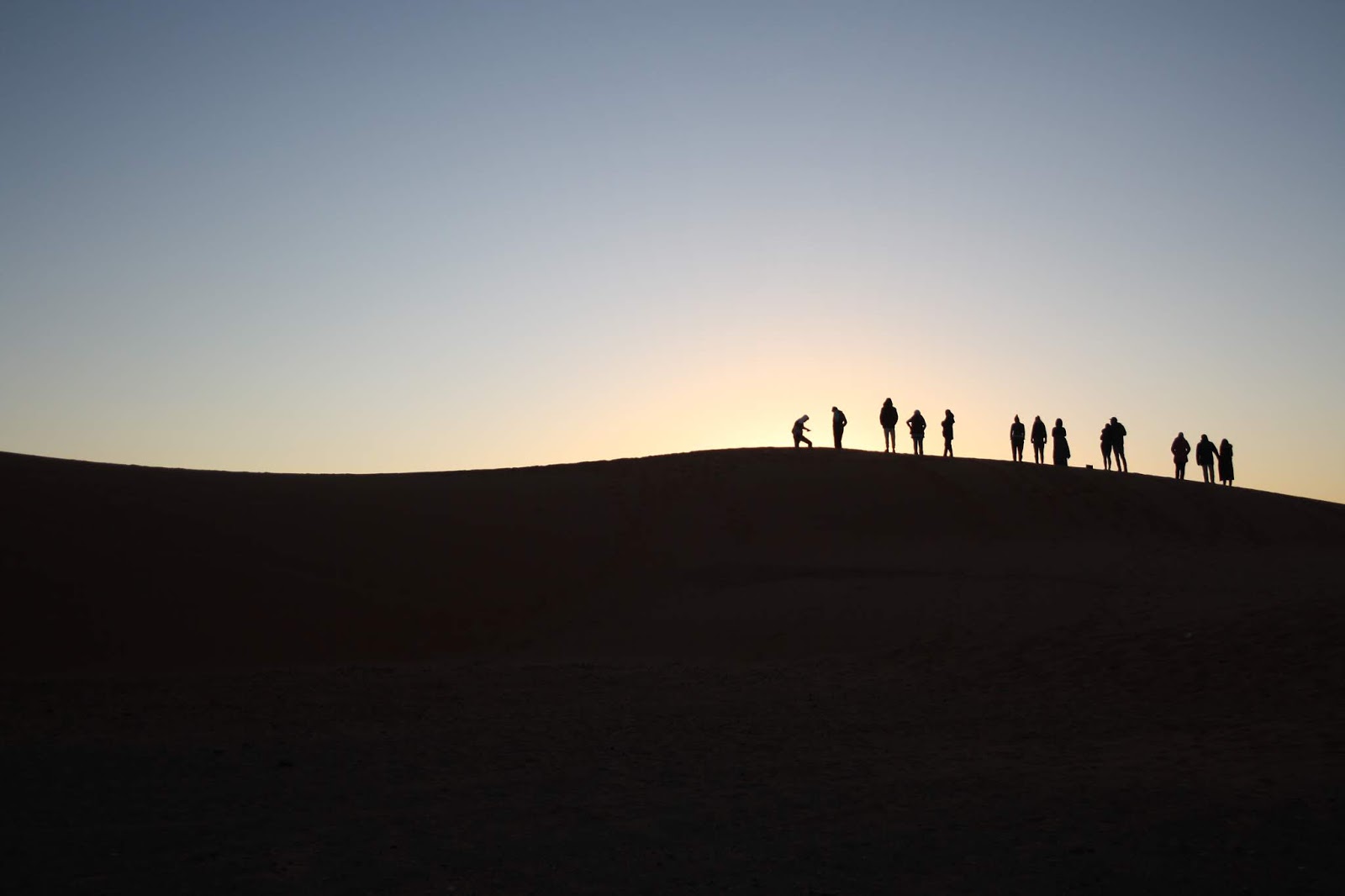
På morgonen väckte de oss tidigt. Till "frukost" fick vi torra brödbitar som blivit över från middagen med lite smör och sylt, och te eller kaffe. Sedan packade vi ihop och gav oss upp på dromedarerna igen för att rida tillbaka i soluppgången. Målet för dagen var Ouarzazate, en annan gammal traditionell by som också använts i flera kända filmer, bland annat Star Wars och Prison Break. Efter lunch på ännu en "turistrestaurang" så var det dags för oss att byta minibuss. Vi blev tillsagda att stanna kvar vid restaurangen i ungefär en halvtimme, och därefter skulle vi bli upplockade av nästa grupp. Dock dröjde det nästan två och en halv timme, så jag hann bli väldigt nojig innan vi äntligen satt i rätt minibuss och var påväg därifrån. Vi påbörjade den långa färden mot den "riktiga" öknen, och vi stannade för att övernatta i vackra Dades Gorge. Det är en stor ravin eller klyfta med kala väggar och väldigt frodiga och gröna dalar. Det var dock väldigt kallt där, och hotellet där vi skulle övernatta hade inte mer än enstaka plusgrader i rummen (men som tur är varmdusch).


Tidigt på morgonen gav vi oss av och körde nästan hela dagen. Vid eftermiddagen var vi äntligen framme i Merzouga. På håll kunde man se de stora sanddynerna som nästan såg ut som kullar eller små berg. Även här fick vi låna varsin dromedar för att bli transporterade lite längre in bland dynerna. När vi stannade tog vi av oss skor och strumpor och tog oss upp för en av de högsta sanddynerna. Där spenderade vi hela eftermiddagen med att ta kort på omgivningen och varandra i väntan på solnedgången. Det blev både svalt och blåsigt innan det var dags att ta sig tillbaka. Ett beslut från regeringen hade kommit bara dagar tidigare om att det skulle bli ett skyddat område, och därför fick man inte övernatta i själva ökenområdet. Istället hade de flyttat lägret med alla tälten till utkanten av staden. Även här fick vi vänta länge på middagen innan vi kunde gå och lägga oss i våra delade tält.


På morgonen fick vi vakna av oss själva, så vi missade själva soluppgången, men passade på att njuta av morgonsolen ändå. Direkt efter frukost fick vi sätta oss i minibussen igen då det väntade en cirka 10 timmar lång bilfärd tillbaka till Marrakech.

På det stora hela var vi nöjda med turen - vi hade såklart uppskattat att få gå runt själva, att slippa "köpstoppen" där de försökte sälja mattor, örter, smycken och annat, och att välja själva var vi skulle äta och hur mycket tid vi skulle spendera var. Men det kändes ändå som ett helt okej alternativ för att slippa ordna med allting själva. Fyra dagar kändes också som en ganska lagom längd; vi var väldigt glada att vi fick möjligheten att komma till sanddynerna i Merzouga, som var betydligt mer imponerande än de i Zagora.