Visar inlägg med etikett marknader. Visa alla inlägg

tisdag, mars 1

Februari 2022 - El Salvador - Santa Ana, Ruta de las Flores (Ataco)

We arrived in Santa Ana in the evening, and the bus which was headed to San Salvador had dropped us off at the side of the road by a gas station. With no internet available, a security guard at the gas station helped us call a taxi, though the guy droves us to the wrong hostel first as he didn't know ours. Thankfully that hostel owner (and Google maps) helped guide us to the right place - La Casa Vieja. The owner, Luis, was very kind and helpful, and immediately gave us information on activities in the area and how to get there, including the restaurant where we went for dinner. 

The national dish of El Salvador is pupusas, which is like tortilla dough stuffed with some vegetable or other ingredient and cheese, and then fried, and its often served with tomato sauce and pickled vegetables. The restaurant we were directed to was a popular place called La Ceiba, which offered as many as 22 different fillings (!) and the choice of corn or rice dough. Some of our favorites were: garlic, cilantro, and carrot.

Our first full day in the country, we decided to take it easy as I was still recovering from my food poisoning as well as the gastritis that hit me after, so we took a chicken bus to Lago de Coatepeque, which is an old crater lake. It is easiest accessed by going to one of the lakefront hostels; our hostel in Santa Ana had a deal with the Captain Morgan hostel by the lake, which meant we got a free "day pass" and could spend a ocuple of hours sunbathing, swimming in the lake, and reading in a hammock with a pretty view. The only downside was the lack of food options; there was basically nothing except for the hostel unless we wanted to walk several kilometers in the mid-day heat.

Lake view

Santa Ana


Chicken bus

The next day we were up extra early to catch the chicken bus heading to the Santa Ana volcano, as there were only two buses per day going. After a long and slow ride, with the bus barely managing to climb the steep hill, we arrived at the parking lot with the other tourists. We were told that it was mandatory to go with a guide, so we all had to pay $3 per person, even though we barely saw the guide (who was at the very front) during the 1,5 hour walk to the summit. At the top we were rewarded with views of the surrounding landscape, as well as of the turqoise crater lake which smelled of sulfur. 


Our next stop in El Salvador was the small town Ataco, situated along the Ruta de las Flores. This route is, as the name suggests, supposedly famous for its many beautiful flowers. However, even though it was "in the right season", we didn't really see that many flowers. We concluded that either there is a better time of the year to see them, or the rumors are a bit exaggerated. Ataco is one of the smaller villages along the route, but it has a lot of charm with its streetart and varieties of food options. There are also the typical souvenir stands along the main roads, selling basically the same souvenirs as we have seen all throughout Central America so far.

Ataco is also the place from where you can explore the El Imposible National Park with "El Salvatours", the one tour company situated in the town. We were a bit hesitant as we found it a bit expensive, but last minute there was another couple who booked the same tour, meaning we got a better price but also some nice company. The tour started with a pretty long drive, with the four of us and our guide standing on the back of the pickup truck. The road into the national park was not very well used, steep and full of holes and we occasionally had to duck to avoid branches hitting us in the head. As we started walking into the jungle, our guide occasionally stopped to tell us about different plants and their medicinal traits. We hiked along a river and its waterfalls, and in several places got to choose between jumping into the water or taking a detour around. In one spot, where the waterfall was high, we put on a harness and were rappelled down with a rope. Eventually, we stopped near a fall where we got homemade tortillas and guacamole for lunch, and where we could rest, swim a bit and enjoy the sun, before starting the steep hike back to the car. Shortly before we reached the end of the "trail", we heard something moving around in the leaves - an armadillo! We even saw another one hurrying across the road as we were driving back. All in all, we had a great time during this hike; it was the perfect amount of adventure, at a place where probably not that many tourists go, and with a great tour guide and good company.


The next day, we decided to explore the other towns along the flower route, traveling with the very cheap local chicken buses. Our first stop was Apaneco, another small village. Apart from some street art, there wasn't too much to see. We did pass some time (and spend some money) walking around in a big maze, which initially confused us as we expected an entry and an exit, rather than having the same entry/exit point and a center. As the maze was placed on a slope, we got plenty of exercise walking up and down the hill before we realized there was a center, and finding our way there.

Our next stop was Juayua, which is perhaps the most popular village to stay in along the route - although we found that we liked Ataco much more. It is most famous for the weekly weekend "food festival", which we were of course excited to see. However, we felt that it was a bit overrated, as it was just two streets serving mostly the same type of dish - meat or fish, with rice and salad. We did manage to find another food stall which served some yuca based dough, filled with cheese and fried - very tasty! We also met up with our friends from the hike and got ourselves some piña coladas made from fresh pineapple and served in the pineapple as well. Very good, but not very strong ^^

Although we felt a bit disappointed in the food festival, we immediately got in a better mood when we returned to Ataco and saw the food market in our own village, which lasted way into the night. Here we tried riguas (also made from yuca), something they called tortas served with cheese and "cream", elote (grilled corn on the cob), chile rellenoi (stuffed peppers) and ponche (a sweet milk-based drink spiced with rum and cinnamon). It was exactly was we wanted from a food market, with lots of local treats to taste.


Yuca with cheese and "cream"

Our last day in El Salvador was spent in the capital, as we had to catch a very early bus the next day to Honduras. We didn't explore much; we stayed at a hotel near the bus terminal, and the area had mainly fast food and not much else to explore. In total we only spent a week in El Salvador, and could very well have spent another one there - doing the popular "7 waterfalls hike" from Juayua, or exploring the surf towns on the coast. However, we had to book our transportation and our acoomodation at the Dive Shop (!) in Honduras a few days in advance, so we had to guess at how many days we would want to stay. Still, we enjoyed our time in the country and felt that we got to explore several nice places and foods!


coffee!

söndag, februari 13

Januari 2022 - Guatemala - Flores, San Pedro La Laguna

 At this point we have been travelling for a month and a half, and we feel like we are really getting into the travel mode. I feel like I'm a bit behind on writing these posts as I am enjoying doing nothing or reading books more than taking the time to write - this truly is a time to relax and enjoy the moment! And so, that's why this first part of Guatemala is getting written as we are about to leave El Salvador. Here are some overall impressions of Guatemala:

  • A colorful country with a lot of culture
  • The breakfast - desayuno tipico - is filling and tasty: many Guatemalan dishes will be served with frijoles and fried plantains, and the avocado is plentiful and always perfectly ripe. We seriously had avocado or guacamole with a majority of all our meals
  • Guatemala has a very clear backpacker trail, which means beautiful places are often also touristy - although that can mean that it's easy to find people who speak a little English, and that you can get an abundance of vegetables in the vegetarian food options
  • People here are kind and helpful, though taxi drivers (especially in the capital) will try to rip you off
  • The local "chicken buses" are repainted old American school buses which reminded us a little bit of the jeepneys in the Philippines 
Let's start at the start. The border crossing from Mexico was very straight forward, the only complicated part was getting the antigen-test in Palenque, as I mentioned in the last post. Our first stop in Guatemala was Flores - a small island in a big lake. Basically, the island is where all the tourists hang out, and on the other side of the bridge, the town of Santa Elena is where most of the locals live. Flores is also the jumping-off point for going to Tikal, the ancient Maya ruins. Booking this tour was one of the first thing we did. Surprisingly, the difference in cost between going with or without a guide was very small, so we decided to go with for a change. We chose to go early in the morning, although not the "sunrise option" which was more expensive. Probably a good choice as well, as it was a rainy day and no sun to be seen.

Going with a guided tour of course meant we had to adapt to the pace of the guide and the group, but we did enjoy getting that bit of extra information. Overall, the temples of Tikal were impressive - huge, and ancient - in the middle of the rainforest. One of the highlights though were of course the wildlife we spotted near the café where we waited for a bit before starting the walk: some different types of wild turkeys, coatis, and some kind of small capybara!


While in Flores, we also took the opportunity to explore some caves just south of Santa Elena. A much less visited site, but definitely worth a visit - although I would recommend some Spanish skills as our guide did not speak any English at all. We opted for the "long tour" (the short option did not require a guide) which was about 2 hours, and included crawling on our bellies through some small openings and walking through quite a big part of the cave system. Definitely a different experience, but pretty cool I'd say! 

the guide instructed me to pose like this, a classic apparently


Another highlight of Flores was taking a boat the short distance across the lake. There are some places to stay there as well, but few options for restaurants and shops. What they do have however, is a viewpoint where you see the island - a perfect postcard picture. There is also a beach where you can hang for a while, and a bar with cheap drinks and snacks just by the water. Watching the sunset from there was just perfect.


At first we were thinking of heading to Semuc Champey next, known for the beautiful waterfalls, but getting there seemed both difficult and expensive, so in the end we decided to get a night bus to the capital and then head to either Lago Atitlán or Antigua. It was almost down to a coin flip; in the end we decided on Lago Atitlán - more specifically, San Pedro La Laguna. There would be a chicken bus heading there without any transfers, so we planned for that. A few things happened on the way, however.

First, we arrived earlier than expected in Guatemala City - 4.30 AM - and it was still dark, so we decided to take a taxi to the bus stop with the San Pedro bus. Even after bargaining hard, we still had to pay quite a lot for the short drive with a guy who had the "taxi" sign in the trunk rather than on the actual car. I'm not 100% sure he was an actual taxi driver. During the drive he also tried to convince us to let him drive us all the way to San Pedro, which would surely have been incredibly expensive. As we arrived to the bus stop he also tried to convince us that there were no buses running that day, and that we should instead let him take us to a hotel. We throught that sounded odd, it was a Monday after all. In the end we just walked away from the taxi and asked a local guy about the bus to San Pedro. He assured us we were in the right location and told us that he was also going there. Five minutes later, the bus arrived!

All good, we thought... until about two hours later, barely halfway to San Pedro when the traffic suddenly stood completely still. Turned out there was a blockade, not letting any vehicles through. No one seemed to know really what was going on, and for a long time we just waited on the bus. Then the other passengers started to leave, and eventually the local guy from the bus station told us (communicating some in Spanish and some via translation app, as he didn't speak much English) that he was going to walk to the other side of the blockade and try to catch another bus there. We followed. 
After that, we alternated between walking (with our big backpacks), waiting by the side of the road, and spending a couple of minutes on a chicken bus, or on a colectivo (so full that we were hanging out of the door). Eventually however, there were no more buses or colectivos as the road was blocked every few kilometers. We started walking more, and trying to hitchhike. Every now and then, someone would let us ride on the back of their truck until the next roadblock. At one point, around 3 PM, we still had more than 30km left and saw fewer and fewer cars passing - we started to lose hope that we would make it to San Pedro (and the hotel we had booked) that day. But how would we spend the night?
Thankfully, just a few kilometers later the blockades eased up, and we just had to take another colectivo, truck and tuktuk before we arrived in our town at 6.30 PM, about 10 hours after we were supposed to arrive. All in all, we had walked around 17km, and mainly eaten some sugar packed snacks that were sold by the side of the road - all the restaurants and shops were also closed - so we were exhausted, but happy, to finally be in San Pedro. All with the help of this local guy who had been able to guide us and talk to people along the way. I can say for certainty that it would not have been possible without him to help us.

Well in San Pedro, we spent a full week. San Pedro is a small and cute, but touristy, town just by the lake, and from our hotel we had a beautiful view of the lake and the mountains and volcanos nearby. We enrolled in Spanish classes, one of the popular acitivities there. Our classroom was a table, a whiteboard and some chairs just by the lake, and our teacher was a local woman who lived nearby. For the next five days, we spent four hours every afternoon improving our Spanish grammar and vocabulary. In the mornings, we would go kayaking to a pretty beach, hike up to the viepoint of Rostro Maya, or just relax. We were hoping to hike the volcanos as well, but most of the travel aggencies were currently not organizing any tours there due to risk of robbery at the summit. While a much shorter hike and lower summit, Rostro Maya still offered a nice experience and incredibly beautiful views from the top. 


Beautiful views from Rostro Maya, with San Pedro town & volcano in the background

Local fisherman / view from our kayaks

Our "classroom"

sunrise over a tiny volcano

We also visited the nearby village San Juan, which was very cute and colorful with plenty of murals, a main street that was just a long market, and plenty of decorations around. On our last day, we took a day trip to Chichicastenango, which hosts one of the largest markets in Central America two times per week. We were hoping to find some nice souvenirs there, but while it was interesting to see, the busy, narrow streets offered either mass produced items for tourists, or fabrics and clothes for the locals. There were some beatiful pieces of fabrics, but they turned out to be table runners (and not scarves, as I was hoping for) so we skipped that and instead bought a pretty painting i San Juan. After a week by the lake we felt relaxed and refreshed, and ready for new adventures in Antigua.

Colorful San Juan La Laguna


Chichicastenango market

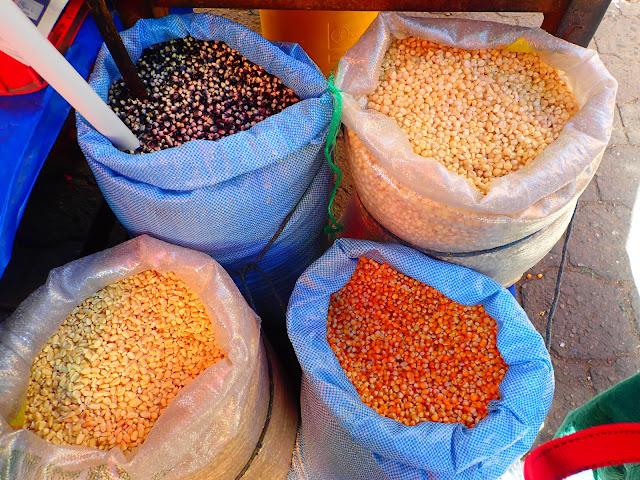
corn!


måndag, januari 31

Januari 2022 - Mexico - Mérida, Bacalar, Mahahual, Palenque

 apologies in advance - this is a long one!

Like Valladolid, Mérida is a town with a lot of colonial buildings, and is known to be a cultural hub in Yucatán. There are a lot of tourists, and therefore also a lot of air conditioned nice restaurants, souvenir shops and even a “food court”/market that directly targets tourists (serving things like pizza, burgers and sushi). As we arrived quite early in the day from Río Lagartos, we only left our bags at our hotel and then headed out to find breakfast. After wandering around quite a while, not really finding anything appealing, we headed towards the main square. There we found the weekly Sunday market which happened to include a number of food stalls. We ordered vegetarian tortas (sandwiches) and they were really good. Somewhat more energized, we went exploring the city, which of course entailed looking at churches. We walked along the famous street Paseo Montejo where all the grand colonial mansions are, and all the way up to the Monumento de Patria.


As we no longer had the ocean breeze, the midday heat was intense, and we found our escape at local food courts for some lemonade or juice. In the evening we returned to the Sunday market for dinner and tried tacos with cochinita pibil as well as a Jamaica juice (made from hibiskus flower), both things that we have seen around Mexico or read about but hadn’t tried yet. We were not disappointed! However, continuing on this trend we decided to also try esquites, which is a snack that we’ve seen all around Mexico and which is very popular among locals: a cup of corn, mayo, cheese and chili. Maybe it’s an acquired taste, or maybe we just didn’t go to the right place – we decided to go for churros instead which is always a hit.

The next day for breakfast, we found a local mercado which would turn out to be a great place for food. As they were only open in the morning, we could go there for breakfast or an early lunch, and also take the opportunity to buy some fresh fruit. Here we tried relleno negro (which gets its black color from charred chilis) and had great panuchos, tortas and huevos


The remaining time in Mérida we spent mostly at museums. There are a few in the center of town that are also free and very nice, including one with contemporary art, and the Palacio del Gobernador. Worth noting however is that several museums have little or no information in English, so at times we had to do with simply looking at the installations and pondering. We wanted to go to the World Maya Museum as well, but it required a bus and despite several tries we could not for the life of us figure out where to catch these buses. Everywhere online we read about Calle 60, and a local travel app also directed us there, but there was not a single bus that passed on Calle 60, so eventually we gave up.

In the evening we went to a cantina to get a feel of the pubs, and we had a very good time. The only downside was the music which was a bit too loud for comfortable conversations, but both the local beers and the mezcal we tried were good. We also got complementary botanas (nachos with a variety of dips) which were “included” but appeared on the tab for 3 pesos which is still a very reasonable price.

After Mérida we felt we had enough city life, and headed back towards the coast. We only spent two days in Bacalar, but we enjoyed them a lot. Bacalar is a small town situated by a big lagoon. The number one activity here is of  course to get out on the water. We chose to do that by kayak. It was a beatufiul morning when we headed out – and we spent the day paddling past islands, scouting for birds, paddling to and swimming in cenotes that were in the actual lagoon, and having a beer on a jetty in the rain. All in all an, adventurous day just in our taste.


Next, we headed out to the seaside in Mahahual, which is a small town south of Tulum and Playa del Carmen, and which consists mainly of a long beach and the hotels and souvenir shops along it. We booked our stay at Blue Kay, which is kind of a fancy resort but that also has very cheap and simple cabañas right by the beach. They also had a gym and free yoga classes. The beach area is dreamy and instagram-friendly, as there are swings on the beach, hammocks in the water and plenty of sunbeds. The one thing that almost ruins the atmosphere but which brings in a big part of the income to this town is the huge cruise ships that arrive daily to drop off hundreds of tourists.


The first thing we did when we came here though was to go to one of the many dive shops in town. From Mahahual, you can dive along the coast , but you can also go out to Banco Chinchorro, a reef about 1-2 hour boatride away which is the more popular location. We picked a 2-day package that would give us one day at the coast and one day at Chinchorro. But first, we get a full day relaxing at the beach, reading books and eating fantastic shrimp tacos at a seafood restaurant where we returned a few times.

Diving at the coast was pretty nice, though “cold” – a mere 27C in the water required us to put on an extra wetsuit so we wouldn’t get too cold. We saw a few nice things – stingrays, turtles, lobsters and a decorator crab. The next day we’re up early to head out to Chinchorro. Our first dive started out well with two nursery sharks that tagged along throughout the dive, but it ended spectacularly – dolphins. First two, then five, then ten, then twenty something dolphins swimming nearby, jumping and playing in the water. We were all amazed by this – not only seeing them but also hearing them, it felt surreal. When we got back to the boat, the waves had gotten pretty big so we head to a nearby island to wait it out a bit. The island was mainly mangrove and we spotted a few crocodiles while we snacked on lunch. After a while it’s clear that the weather is not getting any better, so we need to head back to town. Equipped with rain jackets to protect against the splashing salt water and the worst of the wind, our small boat took on some very big waves. Safe to say we were all grateful when we were able to put our feet in the sand again. The day left us all with a bit of mixed feelings, but in the end – there were dolphins. That was pretty damn awesome.


One of the nights in Mahahual we found a local eatery with Oaxacan food. Fun, we thought, lots of new things on the menu to try! We ordered three of those unknown dishes upon which the waitress looked at us skeptically and explained that they were all quite big. Thus, we settled for only two. When they brought out the first dish, a tlayuda, we realized we would probably have been good with only that! It felt sort of like a pizza, but with a crispy tortilla base instead of bread. The second one, a huaracha (kind of like a very big panucho) had us full to our limits.

Palenque was our last stop in Mexico, and one that we really, really liked. While we had to do some boring stuff here as well, like figuring out where to get a covid antigen test which we needed for Guatemala, the day trips we did were really worth it. Firstly, we booked a waterfall tour. This tour is a full day as they include a few hours of driving. The first of the two waterfalls, Misol-Ha, is a big one with a pool where you can swim. You can also walk along a path behind the waterfall and visit a small cave. Very impressive! The second waterfall, Agua Azul, was even better. Somewhat similar to the Kuang Si falls in Laos the light blue cascades are beautiful to look at. The cascades went on for a huge area, and while the parts near the parking was crowded with tourists and vendors, the further we walked, the more empty it got. A nice walk along the pools, a quick dip in the cool water, and walking across a suspension bridge – and a couple of empanadas with a beer before the drive back was the end of a perfect day.


The next morning we were up early, breakfast hunting on the streets near our hotel. We found a food cart selling tamales for about 12 pesos each, and we were happy to stand on the sidewalk munching on those together with the locals who stopped by on their way to work. After that we took a colectivo to the Maya ruins. Contrary to Chichén Itzá, these ruins are situated in the jungle which provides a lush and mysterious setting. We loved walking around this tranquil area in the morning sun, looking at the different temples. Before heading back to town, we decided to take a walk in the jungle following a trail near the entrance to the ruin. We didn’t really know where the trail would lead us, but were pleasantly surprised to discover several overgrown temples/buildings, hidden away among the trees, and completely by ourselves. We also spotted some howler monkeys high up in the trees. Another excellent adventure that I would highly recommend.


That was all for this long post, keep an eye out for the next one to read about our adventures in Guatemala!