Visar inlägg med etikett städer. Visa alla inlägg

måndag, maj 16

April 2022 - Panama - Santa Catalina, El Valle de Antón, Panama City

Our next destination after Boquete was Santa Catalina, a small village on the Pacific Coast with only a few hotels, hostels, restaurants - and dive shops. Santa Catalina is known as the entry point to go to Coiba National Park, whether you are a scuba diver or just beach hopping for the day. Others come here to surf. Since it was a bit 'off', with few and irregular buses heading there, we decided to take a shuttle. It turned out though that we were only three people going with this shuttle, so it was actually a car rather than a minibus which felt quite luxurious. The hostel was owned by an Italian man and doubled as a café during mornings and pizza place during evenings (though the coffee and bread was better than the pizza).

After going for a lunch, we waited for the dive shop across the street to open, and then headed there to fill out forms and sort the details. We had originally booked only two days of diving, planning to have our third day just to chill on the beach, but after those two days we asked to extend for a third day of diving. Because it was really nice. While we again found ourselves in the "in-between" season where nothing was really in season (no whalesharks, no hammerheads...) we really enjoyed the diving here. We got to see a few different types of sting rays that we haven't seen before (some of them huge!), lots of white tip reef sharks, lots of octopuses, a few seahorses (!) also a kind we haven't seen before, some new types of "fluffy" nudi branchs, and LOTS of turtles. Unfortunately, we don't have any cool photos of these creatures as the underwater casing for our camera was leaking. You'll just have to imagine it.


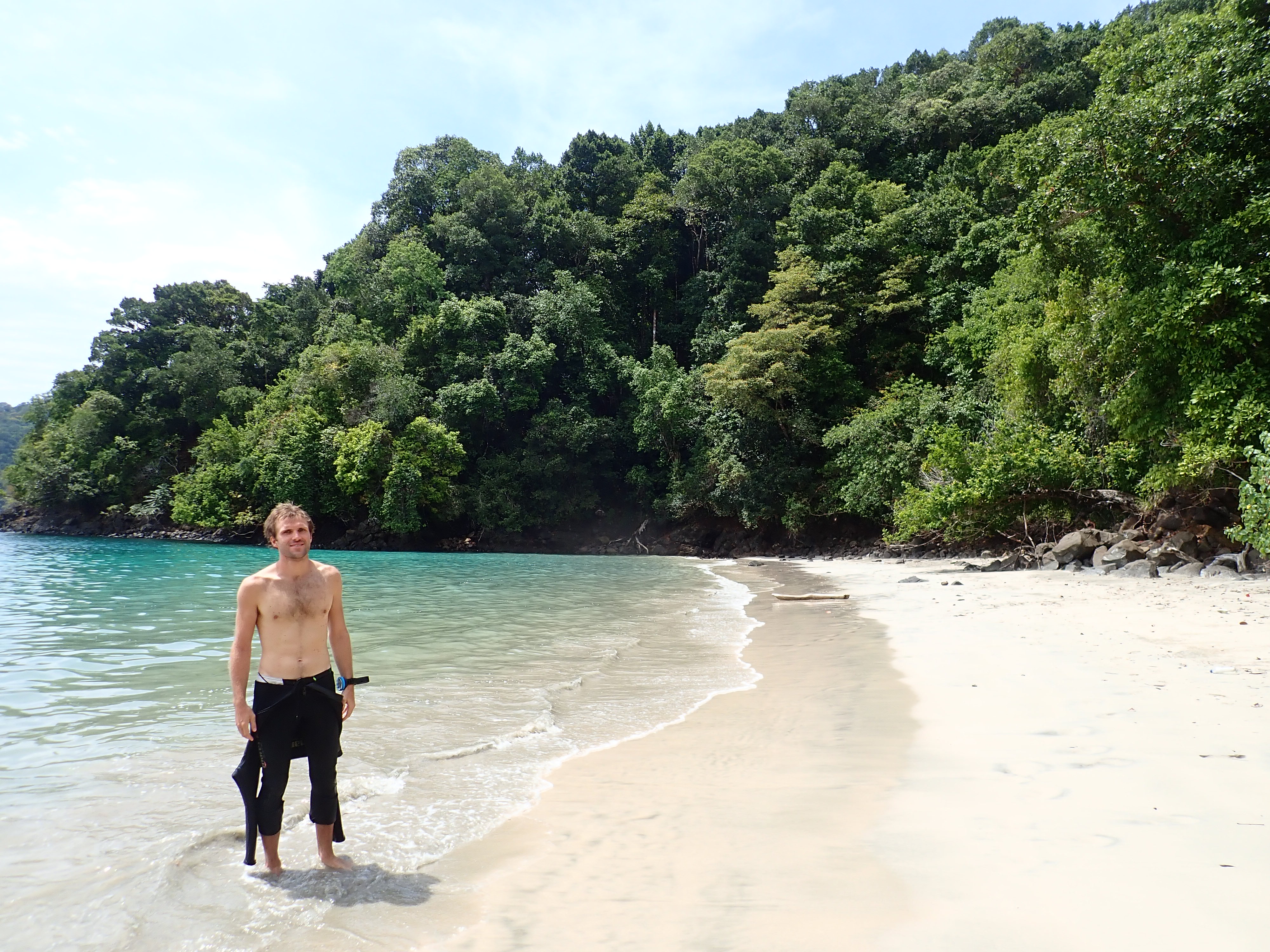
A typical day scuba diving here would look something like this: early breakfast, head out on the boat around 8am, drive to first dive site (1-1,5 hours), then a break on one of the nearby beaches, second dive, longer lunch break on another beach, third dive, boat ride back, shower, snack, hammock time, dinner. And the best part was that these beaches were among the most beautiful we've seen on this trip - picture perfect paradise type beaches with palm trees, beautiful sand, crystal clear turquoise water...Spending a few days here was really amazing. And though we didn't see any of the big stuff we were kind of hoping for, we did get an acrobatic show by some dolphins our last day. Our very last dive unfortunately didn't turn out great - as we descended we ended up in a school of thousands of jellyfish - yes, the kind that sting! Not dangerous, but giving enough of a burn that it was quite uncomfortable swimming the first part of the dive. Once we got out of all the jellyfish, the current was too strong and in the end we had to cut the dive short. When we came back up on the boat, we all had very red lips and burning/itching hands from the stings. Well, it was an experience, as you say!


flying dolphin

Our very last longer stay for this trip was El Valle de Antón, a small town surrounded by the ridges of a very, very old volcano. We picked this destination for our last top due to the proximity to Panama City and the fact that we would be there during part of Semana Santa, Easter week - we wanted to be close to the city to be able to get there easily even if there weren't any buses running during Easter (there were, but we weren't 100% sure). We stayed at a cozy hostel where we could take some free yoga classes (!) and where some of the volunteers hosted a Panamanian Easter dinner with traditional foods such as baked pumpkin, chicken rice, beetroot salad, and some banana-cheese-chocolate roll for dessert. We spent our days hiking (sometimes with a cute, fluffy private guide!), and afternoons reading. 


This was also where I got to spend my birthday. I started the day with yoga, and then we went for a steep (but pretty) hike. The previous days we had lunch at a nice Colombian restaurant (with excellent arepas among other things) though on this day we went to a local place for a huge portion of arroz con camarones (shrimp rice), and then went for ice cream. In the afternoon, we went to some hot springs where you first started by doing a face mask with special mud - and then washed it off and enjoyed soaking in one of the (not super warm) pools. In the evening I had booked a table at probably the second fanciest restaurant in the area. The restaurant belonged to a hotel which was about 2km outside of the small village. We thought it might be very crowded since it was the Easter Friday, but when we came it was nearly empty and seemed to mainly be residents of the hotel eating. Although they unfortunately couldn't serve us any artisanal beer or nice cocktails due to the dry law (not being allowed to serve alcohol during Easter Friday), the food we had was really amazing: corn cobs, cheese fondue with patacones, grilled veggie salad, sweet potato tacos - and for dessert, sopapillos, some sort of fried dough filled with lemon cream and topped with chocolate sauce and cinnamon. Not a bad way to spend a birthday!


The next day we hopped on the bus(es) to the capital - Panama City. On the bus ride to the hotel we passed the bank district and watched the skyscrapers in gold and glass panels from the window. Not the most fancy hostel (our "private bathroom" was only private in the sense that we were the only ones using it - it wasn't actually situated in our room), but good enough for two nights. After a quick lunch we decided to take the long bus ride out to Miraflores, the famous spot for watching ships pass through the Panama Canal. Of course, this must be one of the main sights in the city, but we were still surprised to see the amount of tourists there. The actual museum part was closed when we were there, but for the $10 entrance we got to spend around 30minutes as a big ship was being transported through.


In the evening we managed to find a nice food truck selling burgers - our veggie burger had a patty made from rice, coconut and black beans! - and some nice local craft beers. Our last day, we went to Casco Viejo, or San Felipe, as it's also called, which is the old colonial quarters in the city and offering some cute, fancy coffee shops, monuments, and stalls selling souvenirs and Panama hats. We also got a nice view of the city skyline. We stumbled upon some Easter celebration outside of a church, and randomly ran into our friends Alex & Sarah, who we met in El Salvador (and in Honduras). We enjoyed a fancy coffee, had a pretty amazing lunch at the fish market - pescado de la hembra (breaded fish covered with shrimp in coconut sauce) with patacones, of course - and lastly, called an Uber to take us to the airport...


And this concludes our three and a half month backpacking trip through Central America!
Where to next?


tisdag, april 5

Mars 2022 - Nicaragua - León, Granada

Coming from the cool February weather in Honduras, the moment we stepped off the bus at the border to Nicaragua it felt like we were in the desert. The dry heat and scorching sun caught us a bit off guard. Once again we got dropped off by the side of the road in the dark, as our bus headed to San José while we made León our first stop in the country. León was a nice town with a strong backpacker vibe. Surrounded by volcanoes, there are enough activities to keep you occupied for days. We stayed our first two nights at Vía Vía, a backpacker hostel which also hosted one of the biggest tour agencies in the town - Volcano Day.

The first day we took our time to walk around the city, look at the colorful colonial buildings, and visit museums. First, we visited the Museum of Traditions and Legends, a small museum where we could read about myths, legends, folklore and fables. While the museum itself didn't feel like it was very well-visited, the stories were quite interesting - they seemed a bit weird and crazy, but then again most myths and legends do! It was even more rewarding when we returned to our hostel and saw that they had an entire mural depicting most of these mythical people and creatures; had we not gone to that museum we would have had no idea what we were looking at.

The second museum we visited was Museum of the Revolution. We were a bit surprised to find out that this was not a museum where you go around looking at things yourself. There was a single guide, who himself had participated in the revolution, who walked the tourists around the building and told the whole story, while showing old photographs and articles. With a mix of Spanish and English, he made sure everyone got the full story, even those who joined us when we had only gotten halfway. The tour of the building ended with a very sketchy walk up on the half broken tin roof (which had arrows painted on it to show where you needed to step) to show some views of the city. It was definitely a museum experience out of the ordinary.

view from a sketchy rooftop

In the afternoon, we took a shuttle from our hostel to the beach, which was only $2 for those who had booked a tour with Volcano Day. We spent a few hours reading and watching surfers, and then watched one of the most beautiful sunsets we've seen. Out of all the sunsets that we've seen, this was definitely special.


The next day we went on our Volcano Day tour. They offer tours to most of the surrounding volcanoes, but several of them were very expensive since the roads are pretty bad and you need a 4x4 to reach the starting points. The most popular tour here was to go volcano boarding - basically you get an overall and a board/sled and you get to go down the sandy slopes of Cerro Negro pretty fast. We thought this might be a bit touristy for us (there were big groups going from many different tour operators every day) so we instead picked something we thought would suit us a bit better: an overnight hike to Volcán Telica, around 1030 m high. Our group was very small, as we were joined only by two more people, one of which who was working as a volunteer at the hostel, plus our guide. As we started the hike around midday, the trail up was hot, dry, and dusty. We set up camp near the top and went up to the very big and impressive crater, where we watched the sun set over the volcanoes to the west. In the morning, we walked the short path up to the crater again to watch the sun rise over the volcanoes to the east, before taking a short route down on the other side where the car to take us back was waiting. We had a really nice time at Telica, and the only thing we could complain about was that we wished we got a little more food.


On the topic of food, our go-to in León was a spot behind one of the churches where some women served various grilled treats and you can just point at the ones you want. A lot of them were meat of course, but we also found some nice halloumi-like cheese, cheese filled potato, fried yuca, fried banana and more. Served of course with some salad, and the traditional Nican gallo pinto - rice with beans.

Our next destination in Nicaragua was Granada, a town that felt even more touristy but less backpack-y. A long walking street packed with restaurants selling the same type of food and offering the same happy hour deals, but every single one playing different music - seemed to be targeting mostly local tourists. We found our own favorite spot at Pan de Vida - a brick oven bakery/pizza place with a cozy backyard. While we found their pizza to be more like crisp bread with topping, their huge slices of banana bread, big cinnamon rolls, great coffee, and cocktail deals to match the walking street (2 cocktails for $3) had us coming back on a daily basis.

Like León, Granada also offers volcanoes to see. After inquiring at a tour agency, we decided to visit Volcán Mombacho, 1344 m, on our own, hoping to save some money by taking a chicken bus. However, we found out that it was not really a cheap deal to visit Mombacho. Being an old, tree-covered volcano, it had three walking trails on the top, and the way to that top was about 5km long and very steep. As we got to the ticket office, we were informed that a car ride up would cost an additional $15 on top of the $5 that was the entrance. Then, we would have to pay a second fee depending on which trail we wanted to walk - the shortest one cost only $2, while the longest one which we were hoping to walk, was $6 but also required a guide, which would cost an additional $17 for a Spanish-speaking guide, or $22 for and English-speaking guide. Since we thought the car ride up the mountain was too expensive we wanted to walk up, but figured we would likely be too tired to walk the long trail when we got there, so in the end we only payed $7/person, but indeed we got a lot of exercise!

howler


That road up the mountain was really steep, almost the entire way. At least, we got to see a lot of howler monkeys, and we got a nice view at the top. The heat had us compeltely drenched, though, and tired. Walking down that steep hill again was not much easier. We wanted to take a little detour on our way back and took a chicken bus to Masaya, famous for its craft market. However, we got there tired and hungry and had to hunt down some quesillos (quite similar to pupusas - cheese filled tortillas) first. When we got to the market it was late enough that it was empty of people and most stalls starting to close up, but we did have enough time to find two small vases as souvenirs.

The next day, as our legs needed some rest, we decided to let the upper half of our bodies work instead! We rented kayaks, and headed out among the islets of Granada, 365 small islands in Lake Nicaragua that were formed as a reaulst of an eruption by Mombacho, a very long time ago. It was very beautiful, and quite nice to just paddle around the different islands. Some hosting fancy resorts or houses, while others were home to monkeys, or bats that camouflaged against the bark of a tree. The tamales that we had bought at the market and brought for lunch though was a bit disappointing as they had no flavouring or filling at all, not even salt I think - not at all like the big and tasty nacatamal that we had bought from a kiosk on the square two days before. As we found it was time to paddle pack to mianland, the sun was already high in the sky and we nearly got burnt to crisps before we got back. After another day filled with adventure, we enjoyed some gallo pinto with cheese and tajadas (banana chips here) with an iced cacao drink from our favorite kiosk.


Overall, we preferred León over Granada as we found it to have a nicer atmosphere and better and cheaper food. The cheap and high quality cocktails in Granada was a nice treat though!

tisdag, mars 1

Februari 2022 - El Salvador - Santa Ana, Ruta de las Flores (Ataco)

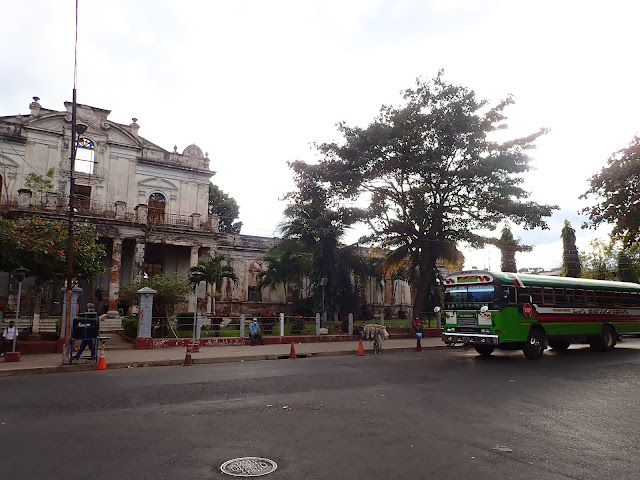
We arrived in Santa Ana in the evening, and the bus which was headed to San Salvador had dropped us off at the side of the road by a gas station. With no internet available, a security guard at the gas station helped us call a taxi, though the guy droves us to the wrong hostel first as he didn't know ours. Thankfully that hostel owner (and Google maps) helped guide us to the right place - La Casa Vieja. The owner, Luis, was very kind and helpful, and immediately gave us information on activities in the area and how to get there, including the restaurant where we went for dinner. 

The national dish of El Salvador is pupusas, which is like tortilla dough stuffed with some vegetable or other ingredient and cheese, and then fried, and its often served with tomato sauce and pickled vegetables. The restaurant we were directed to was a popular place called La Ceiba, which offered as many as 22 different fillings (!) and the choice of corn or rice dough. Some of our favorites were: garlic, cilantro, and carrot.

Our first full day in the country, we decided to take it easy as I was still recovering from my food poisoning as well as the gastritis that hit me after, so we took a chicken bus to Lago de Coatepeque, which is an old crater lake. It is easiest accessed by going to one of the lakefront hostels; our hostel in Santa Ana had a deal with the Captain Morgan hostel by the lake, which meant we got a free "day pass" and could spend a ocuple of hours sunbathing, swimming in the lake, and reading in a hammock with a pretty view. The only downside was the lack of food options; there was basically nothing except for the hostel unless we wanted to walk several kilometers in the mid-day heat.

Lake view

Santa Ana


Chicken bus

The next day we were up extra early to catch the chicken bus heading to the Santa Ana volcano, as there were only two buses per day going. After a long and slow ride, with the bus barely managing to climb the steep hill, we arrived at the parking lot with the other tourists. We were told that it was mandatory to go with a guide, so we all had to pay $3 per person, even though we barely saw the guide (who was at the very front) during the 1,5 hour walk to the summit. At the top we were rewarded with views of the surrounding landscape, as well as of the turqoise crater lake which smelled of sulfur. 


Our next stop in El Salvador was the small town Ataco, situated along the Ruta de las Flores. This route is, as the name suggests, supposedly famous for its many beautiful flowers. However, even though it was "in the right season", we didn't really see that many flowers. We concluded that either there is a better time of the year to see them, or the rumors are a bit exaggerated. Ataco is one of the smaller villages along the route, but it has a lot of charm with its streetart and varieties of food options. There are also the typical souvenir stands along the main roads, selling basically the same souvenirs as we have seen all throughout Central America so far.

Ataco is also the place from where you can explore the El Imposible National Park with "El Salvatours", the one tour company situated in the town. We were a bit hesitant as we found it a bit expensive, but last minute there was another couple who booked the same tour, meaning we got a better price but also some nice company. The tour started with a pretty long drive, with the four of us and our guide standing on the back of the pickup truck. The road into the national park was not very well used, steep and full of holes and we occasionally had to duck to avoid branches hitting us in the head. As we started walking into the jungle, our guide occasionally stopped to tell us about different plants and their medicinal traits. We hiked along a river and its waterfalls, and in several places got to choose between jumping into the water or taking a detour around. In one spot, where the waterfall was high, we put on a harness and were rappelled down with a rope. Eventually, we stopped near a fall where we got homemade tortillas and guacamole for lunch, and where we could rest, swim a bit and enjoy the sun, before starting the steep hike back to the car. Shortly before we reached the end of the "trail", we heard something moving around in the leaves - an armadillo! We even saw another one hurrying across the road as we were driving back. All in all, we had a great time during this hike; it was the perfect amount of adventure, at a place where probably not that many tourists go, and with a great tour guide and good company.


The next day, we decided to explore the other towns along the flower route, traveling with the very cheap local chicken buses. Our first stop was Apaneco, another small village. Apart from some street art, there wasn't too much to see. We did pass some time (and spend some money) walking around in a big maze, which initially confused us as we expected an entry and an exit, rather than having the same entry/exit point and a center. As the maze was placed on a slope, we got plenty of exercise walking up and down the hill before we realized there was a center, and finding our way there.

Our next stop was Juayua, which is perhaps the most popular village to stay in along the route - although we found that we liked Ataco much more. It is most famous for the weekly weekend "food festival", which we were of course excited to see. However, we felt that it was a bit overrated, as it was just two streets serving mostly the same type of dish - meat or fish, with rice and salad. We did manage to find another food stall which served some yuca based dough, filled with cheese and fried - very tasty! We also met up with our friends from the hike and got ourselves some piña coladas made from fresh pineapple and served in the pineapple as well. Very good, but not very strong ^^

Although we felt a bit disappointed in the food festival, we immediately got in a better mood when we returned to Ataco and saw the food market in our own village, which lasted way into the night. Here we tried riguas (also made from yuca), something they called tortas served with cheese and "cream", elote (grilled corn on the cob), chile rellenoi (stuffed peppers) and ponche (a sweet milk-based drink spiced with rum and cinnamon). It was exactly was we wanted from a food market, with lots of local treats to taste.


Yuca with cheese and "cream"

Our last day in El Salvador was spent in the capital, as we had to catch a very early bus the next day to Honduras. We didn't explore much; we stayed at a hotel near the bus terminal, and the area had mainly fast food and not much else to explore. In total we only spent a week in El Salvador, and could very well have spent another one there - doing the popular "7 waterfalls hike" from Juayua, or exploring the surf towns on the coast. However, we had to book our transportation and our acoomodation at the Dive Shop (!) in Honduras a few days in advance, so we had to guess at how many days we would want to stay. Still, we enjoyed our time in the country and felt that we got to explore several nice places and foods!


coffee!